Description
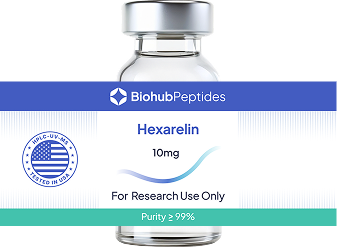
Hexarelin is a synthetic hexapeptide studied in controlled laboratory environments for its potent agonist activity at the growth hormone secretagogue receptor (GHSR-1a), making it a frequently selected tool in research models focused on GH signaling pathways and related downstream effects.
Chemical Information
- Chemical Name: Hexarelin (His-(D-2-Me-Trp)-Ala-Trp-(D-Phe)-Lys-NH2; Examorelin)
- Also Known As: Examorelin; EP 23905; MF-6003
- Compound Class: Synthetic hexapeptide GHSR-1a agonist; broader GHRP selectivity profile with documented CD36 secondary receptor engagement
- Sequence: His-(D-2-Me-Trp)-Ala-Trp-(D-Phe)-Lys-NH2
- Molecular Weight: 887.0 Da (free base)
- CAS Number: 140703-51-1 (free base)
- GHRP selectivity position: Broader than Ipamorelin and GHRP-2; significant ACTH, cortisol, and prolactin co-stimulation at GH-releasing doses; CD36 engagement in cardiac tissue
Applications
- Comparative GHRP selectivity spectrum research. Hexarelin occupies the broad end of the GHRP selectivity spectrum alongside GHRP-6. Systematic four-compound comparison (Hexarelin, GHRP-6, GHRP-2, Ipamorelin) in the same GHSR-1a cell model characterizes the relationship between N-terminal residue identity (His in Hexarelin/GHRP-6, D-Ala in GHRP-2, Aib in Ipamorelin) and receptor selectivity profile
- CD36 scavenger receptor research in cardiac tissue models. CD36 is expressed on cardiomyocytes, cardiac fibroblasts, and coronary endothelial cells. Hexarelin’s CD36 engagement is mechanistically independent of GHSR-1a activation. It operates through separate signaling cascades. This CD36 activity is absent from Ipamorelin and GHRP-2, making Hexarelin the only GHRP compound in the catalog with documented cardiac CD36 biology.
- ACTH co-stimulation mechanism research. Hexarelin’s His N-terminus is associated with the corticotroph ACTH co-stimulation that Ipamorelin’s Aib N-terminus eliminates; experiments using Hexarelin versus Ipamorelin as paired compounds directly attribute ACTH co-stimulation to the His-containing N-terminus structural feature. The glucocorticoid biology downstream of ACTH co-stimulation is itself a research variable in Hexarelin experiments that is absent from Ipamorelin protocols
- GH pulse amplitude at the broad selectivity end. Hexarelin activates GHSR-1a with the same Gq/11-coupled calcium exocytosis mechanism as other GHRPs while adding ACTH/CD36 co-stimulation. GH pulse amplitudes from Hexarelin provide an upper-bound reference for what GHSR-1a agonism plus off-target endocrine activation produces. Comparison against Ipamorelin-driven GH pulse amplitudes at the same GHSR-1a occupancy level quantifies the off-target contribution to the observed GH response
- Acetate salt versus free base comparative analytical research. The Hexarelin Acetate product (CAS 208251-52-9) and the free base Hexarelin (CAS 140703-51-1) provide a defined compound pair for studying how acetate counterion versus free base form affects HPLC retention behavior, mass spectrometry ionization profiles, and aqueous solubility
Storage and Handling
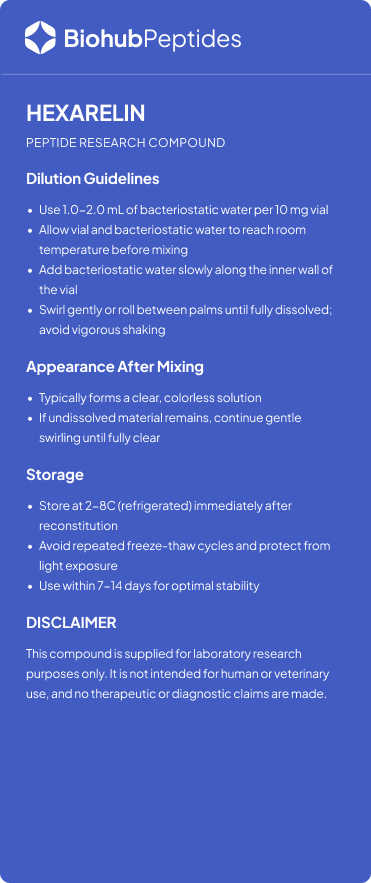
Store lyophilized powder at -20C for long-term stability, or at 2-8C for short-term use. Protect from heat, moisture, and direct light. Store reconstituted solutions at 2-8C and use promptly. Avoid repeated freeze-thaw cycles.
Compliance Notice
Hexarelin is for laboratory research use only. It is not for human or veterinary use and carries no therapeutic, diagnostic, or clinical indication. This product has not been evaluated by the FDA. By purchasing this product, the buyer confirms that they will follow appropriate institutional safety procedures and use it exclusively for controlled research.