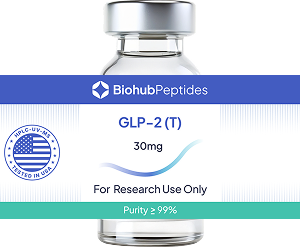
Description
Semaglutide is a long-acting synthetic GLP-1 receptor agonist studied in controlled laboratory environments for its extended activity profile and stable interaction with GLP-1 receptors. Furthermore, its selectivity makes it a practical reference point when comparing across the broader GLP-1 receptor agonist peptide compound class.
Chemical Information
- Chemical Name: Semaglutide
- Also Known As: GLP-1 (S); Ozempic; Wegovy; Rybelsus (research-grade compound is not equivalent to any approved formulation)
- Compound Class: Synthetic lipidated GLP-1 analog; long-acting GLP-1 receptor agonist; Class B GPCR agonist
- Molecular Formula: C187H291N45O59
- Molecular Weight: approximately 4,113 Da
- CAS Number: 910463-68-2
- FDA Status: Approved as Ozempic (type 2 diabetes), Wegovy (weight management), and Rybelsus (oral; type 2 diabetes)
Applications
- GLP-1R Gs-coupled cAMP/PKA and cAMP/EPAC2 signaling studies in pancreatic beta cell models. Glucose-dependent insulin secretion pathway research where the mechanistic question is how cAMP elevation is transduced into insulin granule exocytosis
- Receptor desensitization and downregulation research. Semaglutide’s extended half-life produces sustained receptor occupancy that provides an experimental tool for studying GLP-1R internalization, beta-arrestin recruitment, and receptor downregulation kinetics in cell models under chronic agonist exposure
- Comparative incretin pharmacology. Semaglutide (GLP-1R selective), tirzepatide (GLP-1R/GIP-R dual), and retatrutide (GLP-1R/GIP-R/GCGR triple) provide a systematic series for studying how receptor selectivity profile affects downstream signaling integration in the same cell model
- DPP-4 resistance mechanism research. The Aib8 substitution provides a defined structural model for studying how single amino acid substitutions at the DPP-4 cleavage site affect enzymatic processing and peptide stability, relevant to structure-activity research across the incretin analog class
- Central GLP-1R research in hypothalamic and brainstem neuronal models. Hypothalamic GLP-1R populations are expressed in POMC neurons and connect to autonomic and feeding regulation circuits. Semaglutide’s high receptor affinity and extended half-life make it an appropriate tool for in vitro hypothalamic cell model studies with prolonged receptor occupancy
Storage and Handling
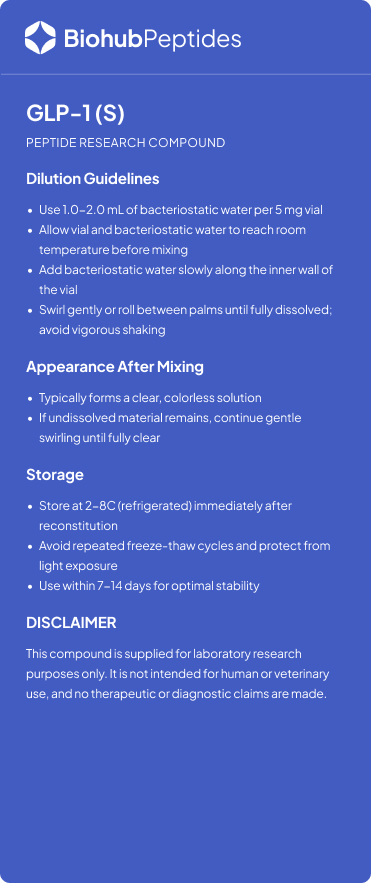
Store lyophilized powder at -20C for long-term stability, or at 2-8C for short-term use. Protect from heat, moisture, and direct light. As a lipidated peptide, semaglutide’s fatty acid chain can interact with reconstitution buffer components. Avoid detergent-containing buffers. Store reconstituted solutions at 2-8C and use promptly. Avoid repeated freeze-thaw cycles.
Compliance Notice
Semaglutide is for laboratory research use only. It is not for human or veterinary use and carries no therapeutic, diagnostic, or clinical indication. FDA approved semaglutide as Ozempic, Wegovy, and Rybelsus. However, the research-grade compound is not equivalent to any approved pharmaceutical formulation and is not manufactured under GMP conditions. By purchasing this product, the buyer confirms that they will follow appropriate institutional safety procedures and use it exclusively for controlled research.