Description
Retatrutide is a synthetic triple receptor agonist studied in controlled laboratory environments for its simultaneous activation of GLP-1, GIP, and glucagon receptors. As a triple agonist, Retatrutide represents the most complex end of the GLP-1 receptor agonist peptide compound class currently used in metabolic signaling research.
Chemical Information
- Chemical Name: Retatrutide (LY3437943; triple GIP/GLP-1/glucagon receptor agonist)
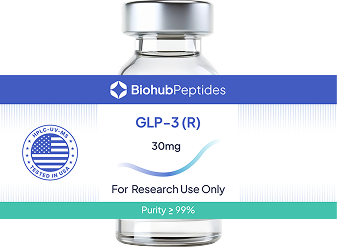
- Also Known As: GLP-3 (R); LY3437943
- Compound Class: Synthetic triple incretin receptor agonist; Class B GPCR pan-agonist (GIP-R, GLP-1R, GCGR)
- Molecular Weight: approximately 4,900 Da
- CAS Number: 2381090-04-4
- Key structural features: 39-amino acid GIP-backbone peptide; Aib2 (DPP-4 resistance), Aib20, and alpha-methyl-L-leucine at position 13 as non-coded amino acid residues; C20 fatty diacid moiety for albumin binding; half-life approximately 6 days
Applications
- Triple Class B GPCR simultaneous activation studies. Retatrutide enables experimental models where GIP-R, GLP-1R, and GCGR are co-activated in the same cell preparation. Appropriate controls require single-receptor agonists for each of the three receptors plus all dual combinations, since overlapping but anatomically distinct receptor distributions create different signaling contexts in different cell types
- GCGR hepatic glucose production pathway research. GCGR activation drives glucagon receptor-mediated cAMP elevation in hepatocytes, activating glycogenolysis and gluconeogenesis gene programs. Retatrutide adds GCGR agonism to an incretin framework, enabling study of how net opposing glucose signals are integrated when all three receptors are simultaneously engaged
- Energy expenditure pathway research. The GCGR component activates thermogenic pathways in adipose and brown adipose tissue models; comparing retatrutide to tirzepatide (dual, no GCGR) in the same adipocyte model isolates the GCGR-specific contribution to energy expenditure gene programs
- Hepatic steatosis mechanism research. Phase 2a MASLD data (Nature Medicine 2024) documented up to 82% liver fat reduction; GCGR agonism drives hepatic fatty acid oxidation gene programs complementing GLP-1R-mediated reductions in hepatic lipid synthesis. In vitro hepatocyte models using retatrutide can probe the mechanism of these complementary hepatic lipid pathway effects
- Structural biology reference research. Cell Discovery 2024 cryo-EM data resolved retatrutide bound simultaneously to GLP-1R, GIPR, and GCGR in complex with Gs, confirming that a single peptide can achieve functionally meaningful engagement across three distinct Class B GPCRs. The three structures provide reference data for studying how N-terminal residue interactions at each receptor create distinct conformational activation patterns
Storage and Handling
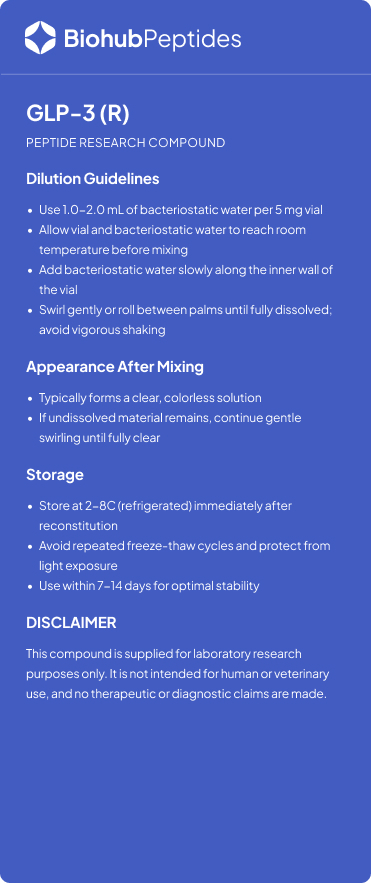
Store lyophilized powder at -20C for long-term stability, or at 2-8C for short-term use. Protect from heat, moisture, and direct light. As a lipidated peptide with albumin-binding fatty diacid modification, avoid detergent-containing reconstitution buffers. Store reconstituted solutions at 2-8C and use promptly. Avoid repeated freeze-thaw cycles.
Compliance Notice
Retatrutide is for laboratory research use only. It is not for human or veterinary use and carries no therapeutic, diagnostic, or clinical indication. Furthermore, it is an investigational compound under Phase III clinical development with no approved indication and no legal compounding pathway. This research-grade compound is not equivalent to any clinical formulation, and therefore it is not evaluated by the FDA. By purchasing this product, the buyer confirms that they will follow appropriate institutional safety procedures and use it exclusively for controlled research.