
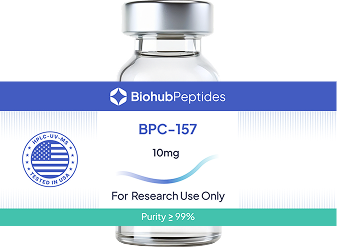
Description
BPC-157 is a synthetic pentadecapeptide studied in controlled laboratory environments for its interaction with cellular signaling pathways associated with localized tissue processes and vascular biology.
Chemical Information
- Chemical Name: BPC-157 (Body Protection Compound 157)
- Also Known As: PL-10; PLD-116; pentadecapeptide BPC 157
- Compound Class: Synthetic pentadecapeptide (derived from partial sequence of human gastric juice protein BPC)
- Sequence: Gly-Glu-Pro-Pro-Pro-Gly-Lys-Pro-Ala-Asp-Asp-Ala-Gly-Leu-Val
- Molecular Formula: C62H98N16O22
- Molecular Weight: 1,419.5 g/mol
- CAS Number: 137525-51-0
Applications
- VEGFR2 receptor activation and internalization studies in endothelial cell models. Chick chorioallantoic membrane (CAM) assay, tube formation assay, and hind limb ischemia models are established in vitro and in vivo systems for this research
- Dual angiogenic pathway dissection research. VEGF-dependent (VEGFR2-Akt-eNOS) versus VEGF-independent (Src-Caveolin-1-eNOS) cascade comparison using selective inhibitors (dynasore for endocytosis; Src inhibitors for the Cav-1 pathway; L-NAME for eNOS)
- FAK/paxillin focal adhesion complex research in fibroblast and endothelial migration models. Scratch-wound assays with FAK Tyr-397 phosphorylation as the primary biochemical readout
- Egr-1 transcription factor activation studies. BPC-157 drives Egr-1 expression, which regulates VEGF, PDGF, and TGF-beta gene transcription programs documented in hippocampal ischemia models
- Gastrointestinal epithelial cytoprotection research. BPC-157 demonstrates stability in gastric acid, pepsin, and intestinal protease assays, supporting its use in GI epithelial signaling models where peptide stability under physiological conditions is a variable
- Enteric nervous system research. Wang et al. 2019 (Neuroscience Bulletin) documented BPC-157 effects on enteric neuron survival and dopaminergic/serotonergic neurotransmitter system modulation in animal models, representing independent replication outside the primary Sikirić research group
Note: The published evidence base is extensive at the preclinical level but is concentrated within a single research group (Sikirić, University of Zagreb). Limited independent replication from unaffiliated laboratories exists. No completed Phase II randomized controlled human trial exists.
Storage and Handling
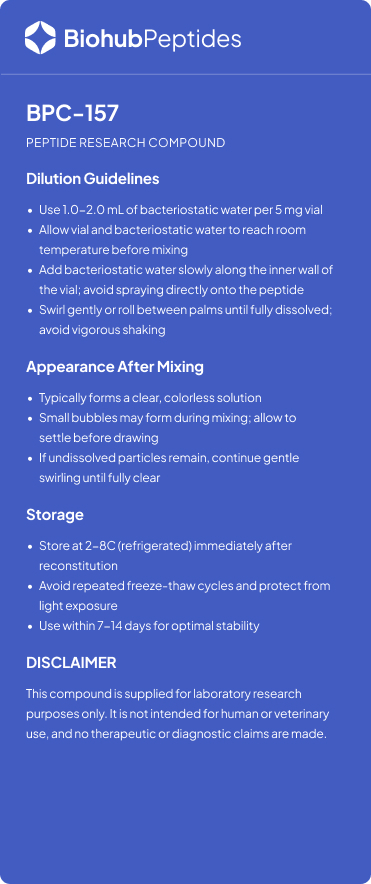
Store lyophilized powder at -20C for long-term stability, or at 2-8C for short-term use. Protect from heat, moisture, and direct light. BPC-157 is notably stable in gastric acid and protease conditions due to its proline-rich sequence, but this does not substitute for appropriate lyophilized storage. Store reconstituted solutions at 2-8C and use promptly. Avoid repeated freeze-thaw cycles.
Compliance Notice
BPC-157 is for laboratory research use only. It is not for human or veterinary use and carries no therapeutic, diagnostic, or clinical indication. This product has not been evaluated by the FDA. By purchasing this product, the buyer confirms it will use it exclusively for controlled research following appropriate institutional safety procedures.



