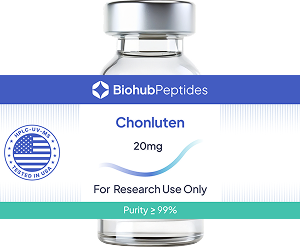
Description
VIP (Vasoactive Intestinal Peptide) is an endogenous 28-amino acid neuropeptide. It is not a Khavinson bioregulator or a small-molecule tool. Instead, it’s a naturally occurring signaling peptide from the secretin peptide superfamily that includes secretin, PACAP, glucagon, GLP-1, GIP, and GHRH. As such, it is considered a specialty research peptide. It was first isolated from porcine intestine but is expressed throughout the nervous system, gastrointestinal tract, immune tissue, and pancreatic islets. VIP binds two Class B GPCRs, VPAC1 and VPAC2, with comparable affinity, activating Gs-coupled cAMP signaling that phosphorylates CREB and drives downstream gene expression. Its circadian clock regulation angle is distinctive. Per1 and Per2 promoters contain CRE domains, meaning VIP-mediated CREB phosphorylation directly regulates molecular clock gene expression through VPAC2 receptor signaling.
Chemical Information
- Chemical Name: VIP (Vasoactive Intestinal Peptide)
- Also Known As: Vasoactive Intestinal Polypeptide; Vasointestinal Peptide
- Compound Class: Naturally occurring 28-amino acid neuropeptide; member of the secretin/glucagon peptide superfamily
- Sequence: His-Ser-Asp-Ala-Val-Phe-Thr-Asp-Asn-Tyr-Thr-Arg-Leu-Arg-Lys-Gln-Met-Ala-Val-Lys-Lys-Tyr-Leu-Asn-Ser-Ile-Leu-Asn-NH2
- Molecular Formula: Not established with a single confirmed public source (approximate molecular weight below)
- Molecular Weight: Approximately 3,326 Da
- CAS Number: 37221-79-7
Applications
- Neuropeptide signaling and receptor pharmacology research. VIP is a reference ligand for the VPAC1 and VPAC2 G-protein-coupled receptors, used to study adenylate cyclase/cAMP-mediated signaling in neuronal, immune, and epithelial cell models
- Vascular and smooth muscle relaxation research. VIP is a potent vasodilator and smooth muscle relaxant. It is used in cardiovascular and gastrointestinal research models studying vasodilation, tracheal relaxation, and gut smooth muscle activity
- Gastrointestinal secretion and endocrine signaling research. Published work has examined VIP’s stimulatory effects on pancreatic and biliary secretion, hepatic glycogenolysis, and insulin/glucagon release, positioning it as a research tool for studying gastrointestinal-endocrine crosstalk
- Neuroimmune and neuroprotective signaling research. VIP has neuroprotective and immunomodulatory activity, so research models use it to examine its role as a neurotransmitter and neuromodulator across the central and peripheral nervous systems
- Comparative secretin/glucagon superfamily research. VIP shares structural homology with secretin, glucagon, and gastric inhibitory peptide. Therefore, researchers use it in comparative receptor-selectivity research within this peptide hormone family
Storage and Handling
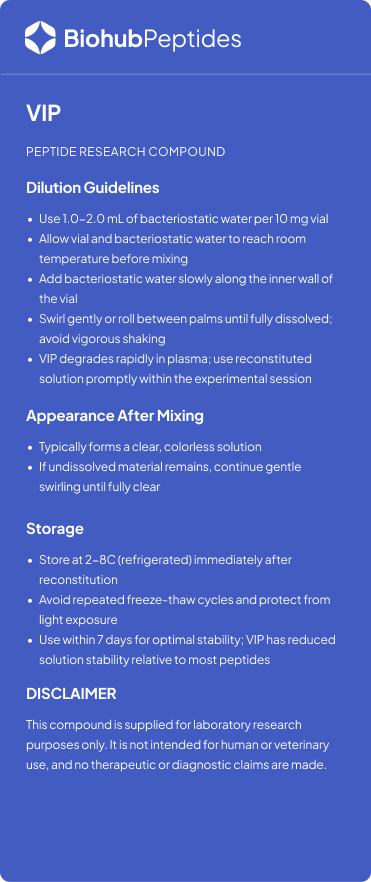
Store lyophilized powder at -20C for long-term stability, or at 2-8C for short-term use. Protect from heat, moisture, and direct light. Reconstitute with sterile water or an appropriate aqueous buffer immediately before use. Store reconstituted solution at 2-8C and avoid repeated freeze-thaw cycles.
Compliance Notice
VIP is for laboratory research use only. They are not for human or veterinary use and carry no therapeutic, diagnostic, or clinical indication. FDA has not evaluated this product. By purchasing this product, the buyer confirms that they will follow appropriate institutional safety procedures and use it exclusively for controlled research.