Description
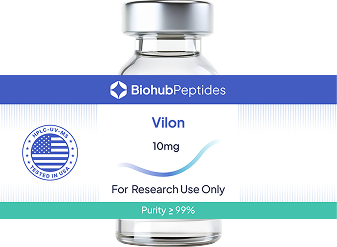
Vilon is a synthetic dipeptide with the sequence Lys-Glu (KE), isolated from Thymalin through fractionation. It is developed as a defined immune system bioregulator within the Khavinson series. Its minimal size supports rapid cellular access and makes it a tractable model for studying how the shortest possible peptide sequences encode biologically meaningful tissue-specific information. Vilon targets thymic tissue and T-lymphocyte populations. T-helper activation through suppression of programmed cell death, not increased cell division, distinguishes it from other immune compounds in the specialty research peptide index.
Chemical Information
- Chemical Name: Vilon (L-lysyl-L-glutamic acid)
- Also Known As: Lys-Glu; lysylglutamic acid; AB-17
- Compound Class: Synthetic dipeptide; geroprotective and immunomodulatory bioregulator (Khavinson series)
- Sequence: Lys-Glu
- Molecular Formula: C11H21N3O5
- Molecular Weight: 275.3 g/mol
- CAS Number: Not independently confirmed
Applications
- Geroprotective and aging-biology research. Vilon is studied in Russian gerontology literature as a geroprotective agent, positioning it alongside Epithalon as one of the more aging-research-focused compounds in the Khavinson dipeptide/tripeptide series
- Monocyte/macrophage inflammatory signaling research. Published in vitro work using the human THP-1 monocytic cell line found that Vilon, alongside Epithalon, Thymogen, Thymalin, and Chonluten, modulated LPS-stimulated cytokine output and proliferative signaling — researchers use this shared dataset to compare relative anti-inflammatory and immunomodulatory effects across the Khavinson peptide family
- Comparative dipeptide bioregulator research. As one of the simplest Khavinson-series compounds (a single dipeptide with a defined structure), Vilon is a reference point in structure-activity research comparing di-, tri-, and tetrapeptide bioregulators (e.g., Thymogen, Chonluten, Epithalon) for immunomodulatory and geroprotective potency
- Note on evidence base: Published data on Vilon are concentrated in Russian-language pharmacological and gerontology literature; independent Western replication is more limited
Storage and Handling
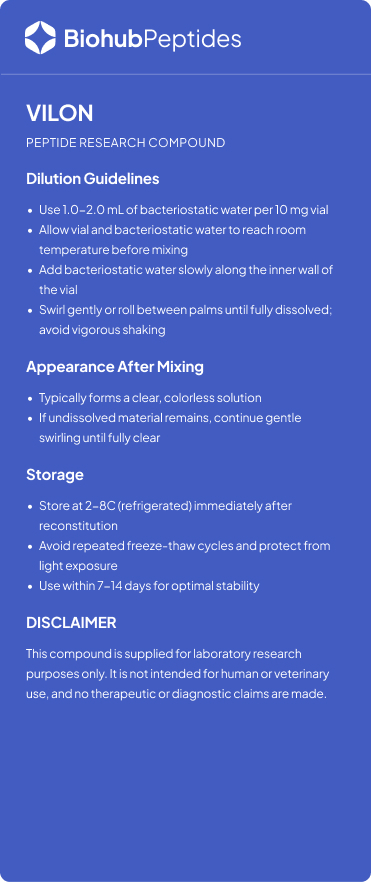
Store lyophilized powder under refrigeration (2-8C), protected from heat, light, and moisture. Vilon dissolves readily in aqueous buffer; store reconstituted solution at 2-8C and use promptly, avoiding repeated freeze-thaw cycles.
Compliance Notice
Vilon is for laboratory research use only. They are not for human or veterinary use and carry no therapeutic, diagnostic, or clinical indication. FDA has not evaluated this product. By purchasing this product, the buyer confirms that they will follow appropriate institutional safety procedures and use it exclusively for controlled research.