Description
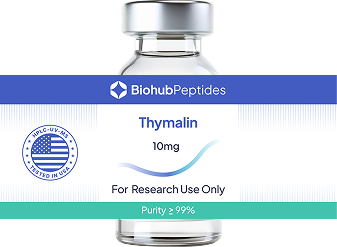
Thymalin is a standardized polypeptide complex originally isolated from calf thymus glands, containing multiple bioactive peptide fractions in the 1,000–10,000 dalton molecular weight range. It is structurally unlike most other compounds. It is not a single defined sequence. Instead, it is a characterized extract whose primary active components have been identified as the dipeptides glutamyl-tryptophan (EW, the basis of Thymogen) and lysyl-glutamic acid (KE, the basis of Vilon). It targets the thymus, the organ responsible for T-cell maturation that undergoes progressive involution with age. Thymalin received pharmaceutical registration in Russia in 1982. So far, it has the most extensive clinical research record in the Khavinson portfolio, including a 6-year observational study in elderly subjects.
Chemical Information
- Chemical Name: Thymalin (Khavinson thymic polypeptide complex)
- Also Known As: Thymalin peptide complex
- Compound Class: Naturally derived polypeptide complex isolated from calf thymus tissue
- Sequence: Not applicable. Thymalin is a multi-peptide complex rather than a single defined sequence
- Molecular Formula: Not applicable; mixture of polypeptides, not a single chemical entity
- Molecular Weight: Reported in the range of approximately 1,000-6,000 Da across its constituent polypeptides
- CAS Number: Not established for the complex as a whole
Applications
- Thymic and immune-system regulation research. Thymalin is a mixture of low molecular weight polypeptides isolated from calf thymus, used in research on thymus-dependent immune regulation and T-cell-related signaling, distinguishing it from the single-molecule short-chain Khavinson bioregulators
- Monocyte/macrophage inflammatory signaling research. In vitro work using the human THP-1 monocytic cell line found that Thymalin, alongside Epithalon, Vilon, Thymogen, and Chonluten, modulated LPS-stimulated cytokine output and proliferative signaling. Researchers use this shared dataset to compare relative anti-inflammatory and immunomodulatory effects across the Khavinson peptide family
- Comparative immunomodulatory bioregulator research. Thymalin is a complex extract rather than a single synthetic peptide. As such, it is used alongside single-molecule Khavinson peptides such as Thymogen and Vilon to explore whether extract-based and single-molecule preparations produce comparable immunomodulatory outcomes
Storage and Handling
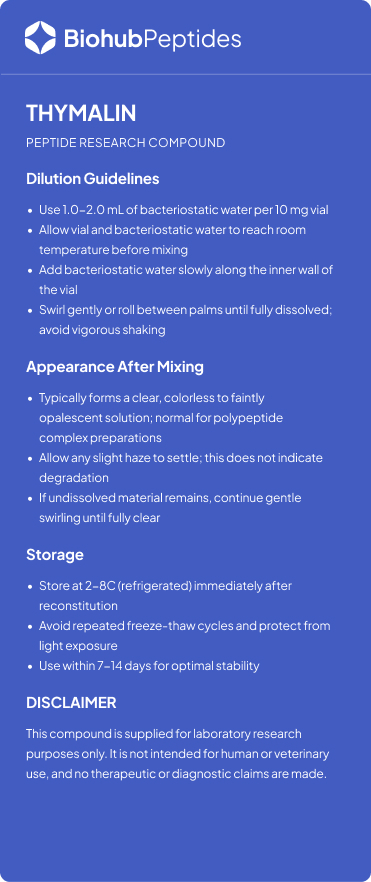
Store lyophilized powder under refrigeration (2-8C), protected from heat, light, and moisture. As a polypeptide complex, Thymalin is susceptible to degradation once reconstituted. Reconstitute immediately before use, keep reconstituted solution refrigerated, and avoid repeated freeze-thaw cycles.
Compliance Notice
Thymalin is for laboratory research use only. They are not for human or veterinary use and carry no therapeutic, diagnostic, or clinical indication. FDA has not evaluated this product. By purchasing this product, the buyer confirms that they will follow appropriate institutional safety procedures and use it exclusively for controlled research.