Description
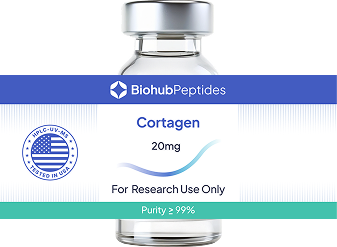
Cortagen is a synthetic tetrapeptide bioregulator that Professor Vladimir Khavinson developed at the St. Petersburg Institute of Bioregulation and Gerontology. Its sequence derives from directed amino acid analysis of Cortexin, a natural polypeptide preparation extracted from bovine cerebral cortex tissue. This makes Cortagen the defined synthetic analog of that earlier crude extract. Within the Khavinson bioregulator framework, Cortagen targets cortical neurons specifically, entering the cell nucleus and binding DNA promoter sequences to modulate gene expression in cerebral cortex tissue. This intranuclear mechanism places it in a distinct research class from CNS-active compounds like Semax, which targets BDNF expression through melanocortin receptor interaction at the cell surface.
Chemical Information
- Chemical Name: Cortagen (Khavinson cerebral cortex-derived peptide bioregulator)
- Also Known As: Cortagen peptide complex; cortical tissue bioregulator
- Compound Class: Short-chain synthetic peptide; tissue-specific epigenetic bioregulator (Khavinson series)
- Sequence: Not established in public literature — vendor sources vary and should be confirmed against the certificate of analysis
- Molecular Formula: Not established in public literature
- Molecular Weight: Not established in public literature (consistent with the broader Khavinson class of low molecular weight peptides, <10,000 Da)
- CAS Number: Not established in public literature
Applications
- Cerebral cortex and neuronal gene-regulation research. Cortagen is used as a tissue-targeted tool for studying cortex-specific transcriptional programs, in the same experimental tradition as Cartalax (chondrocytes) and Cardiogen (cardiomyocytes). Each peptide is proposed to act through the same DNA-binding mechanism restricted to its designated tissue type
- Comparative neuroprotection and hypoxic stress research. Published work on structurally related cortex- and pineal-targeted Khavinson peptides (Cortexin, Pinealon) has examined caspase-3 activity and learning performance in aged versus young animal models under acute hypoxic stress. Cortagen is studied within this same comparative framework to probe tissue-restricted versus tissue-general neuroprotective signaling
- Cross-tissue bioregulator specificity research. Because Cortagen, Cartalax, and Cardiogen are proposed to share an intranuclear DNA-interaction mechanism while differing only in cell-type targeting, researchers use cross-tissue panels of these peptides to test whether reported effects are genuinely tissue-restricted or reflect shared, non-specific peptide-DNA binding
- Note on evidence base: Published data are mostly in Russian-language and Khavinson-network literature and are largely preclinical. There is very little of independent Western replication of Cortagen specifically
Storage and Handling
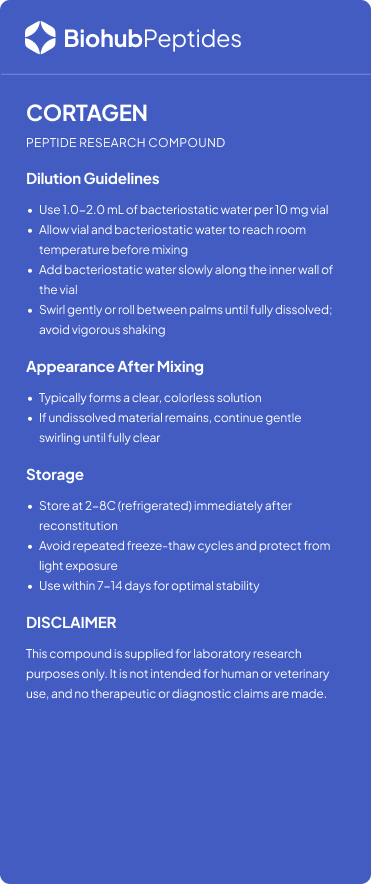
Store lyophilized powder under refrigeration (2-8C), protected from heat, light, and moisture. As a short-chain peptide, Cortagen is susceptible to degradation once reconstituted. Reconstitute immediately before use, keep reconstituted solution refrigerated, and avoid repeated freeze-thaw cycles.
Compliance Notice
Cortagen is for laboratory research use only. It is not for human or veterinary use and carries no therapeutic, diagnostic, or clinical indication. This product has not been evaluated by the FDA. By purchasing this product, the buyer confirms that they will follow appropriate institutional safety procedures and use it exclusively for controlled research.