Description
GHRP-2 is a synthetic hexapeptide growth hormone secretagogue, also known by its pharmaceutical name pralmorelin, developed as a second-generation GHSR-1a agonist with improved receptor selectivity relative to its predecessor GHRP-6. It activates the growth hormone secretagogue receptor type 1a (GHSR-1a) through Gq/11 protein coupling — triggering phospholipase C activation, IP3 and DAG generation, and intracellular calcium mobilization that drives GH-containing secretory granule exocytosis from anterior pituitary somatotrophs. Researchers studying GH axis signaling and ghrelin receptor pharmacology use GHRP-2 specifically when cleaner GHSR-1a activation — with reduced orexigenic and cortisol co-stimulation confounds — is the experimental priority.
Chemical Information
- Chemical Name: GHRP-2 (D-Ala-D-2-methyl-Trp-Ala-Trp-D-Phe-Lys-NH2)
- Also Known As: Pralmorelin; KP-102
- Compound Class: Synthetic hexapeptide; growth hormone secretagogue (ghrelin/GHS-receptor agonist)
- Sequence: D-Ala-D-2-methyl-Trp-Ala-Trp-D-Phe-Lys-NH2
- Molecular Formula: C45H55N9O6
- Molecular Weight: 817.98 g/mol
- CAS Number: 158861-67-7
Applications
- GH-axis secretagogue mechanism research. GHRP-2 binds and activates the growth hormone secretagogue receptor (GHS-R1a), the same receptor that endogenous ghrelin targets. This triggers a Gq/phospholipase-C-mediated calcium signaling cascade in pituitary somatotrophs that stimulates GH release. Also, it is used to characterize this pathway in comparison with GHRH-receptor agonists (Sermorelin, Tesamorelin, CJC-1295), which act through a distinct GHRH-receptor/cAMP pathway
- GHRP-2 vs. GHRH-analog synergy research. Co-administration protocols pairing GHRP-2 (or GHRP-6) with a GHRH analog are a standard experimental design for studying the synergistic amplification of GH pulse amplitude that occurs when both receptor pathways are activated together
- Appetite and ghrelin-receptor pathway research. GHS-R1a activation also has links to appetite stimulation independent of GH release. GHRP-2 produces a measurable, dose-dependent appetite effect, used in research models separating the GH-secretory and orexigenic arms of ghrelin-receptor signaling
- Cortisol/ACTH co-release research. GHRP-2 also produces modest ACTH/cortisol elevation, attributed to its ghrelin-receptor activity outside the pituitary. This is used as a comparator against more GH-selective secretagogues such as Ipamorelin, which activate GHS-R1a with reduced cortisol and prolactin co-release
- Note on evidence base: GHRP-2’s pharmacology is well characterized in the endocrinology literature relative to newer-generation GHRPs, given its longer research history
Storage and Handling
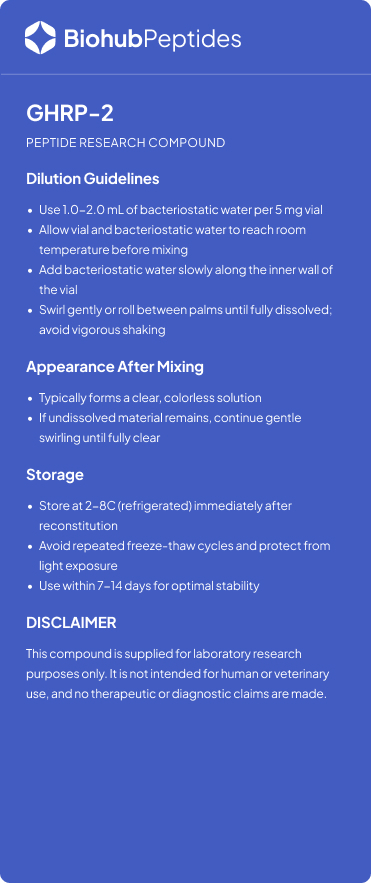
Store lyophilized powder at -20C for long-term stability, or at 2-8C for short-term use. Protect from heat, moisture, and direct light. Reconstitute with bacteriostatic or sterile water immediately before use. Store reconstituted solution at 2-8C and use promptly, avoiding repeated freeze-thaw cycles.
Compliance Notice
GHRP-2 is for laboratory research use only. It is not for human or veterinary use and carries no therapeutic, diagnostic, or clinical indication. This product has not been evaluated by the FDA. By purchasing this product, the buyer confirms that they will follow appropriate institutional safety procedures and use it exclusively for controlled research.