Description
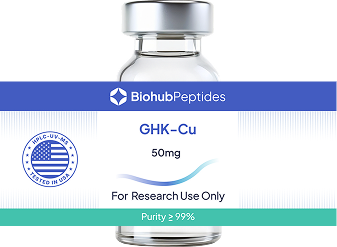
GHK-Cu is a copper-binding tripeptide studied in controlled laboratory environments for its interaction with gene expression pathways, extracellular matrix remodeling processes, and antioxidant signaling behavior within broader cellular regulation research models.
Chemical Information
- Chemical Name: GHK-Cu (Glycyl-L-histidyl-L-lysine copper(II) complex; Copper Tripeptide-1)
- Also Known As: Copper Tripeptide-1; GHK-copper; Cu-GHK; INCI: Tripeptide-1 Copper
- Discovery: First isolated from human plasma albumin by Loren Pickart and Melvin Thaler in 1973; initially characterized for its ability to stimulate liver cell regeneration in aged plasma
- Compound Class: Endogenous copper-binding tripeptide; ECM remodeling signaling molecule
- Sequence: Gly-His-Lys
- Molecular Formula: C14H24N6O4Cu (copper complex)
- Molecular Weight: 401.9 g/mol
- CAS Number: 49557-75-7
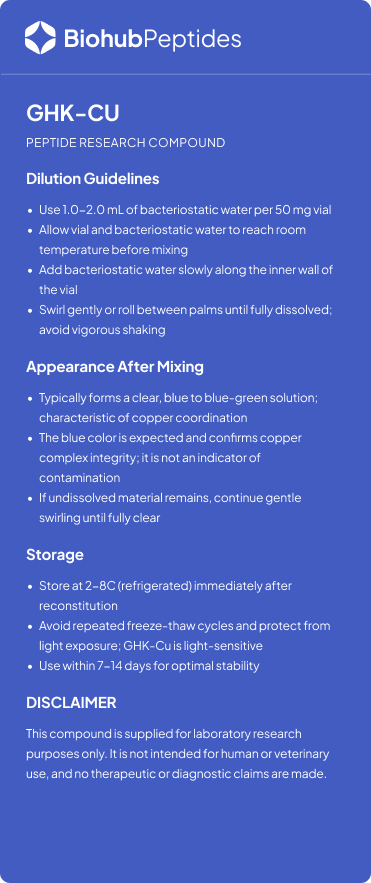
- Copper coordination: Cu2+ coordinated through histidine imidazole nitrogen; 1:1 peptide-copper stoichiometry; characteristic blue color of solution confirms intact coordination
- Effective concentration: Picomolar to nanomolar; exceptionally low effective concentrations; most cosmetic actives require micromolar-millimolar for measurable cell-culture effects
- Appearance: Blue powder and blue solution (characteristic of Cu2+ coordination)
Applications
- Balanced MMP/TIMP modulation research. GHK-Cu demonstrates dual ECM regulatory activity. It simultaneously upregulates MMP-2 (gelatinase; degrades damaged collagen fragments enabling matrix turnover) and stimulates TIMP-1 and TIMP-2 secretion (Simeon et al. 2000; Badenhorst et al. 2016)
- Glycosaminoglycan and proteoglycan synthesis research. GHK-Cu drives parallel synthesis of dermatan sulfate, chondroitin sulfate, and the small proteoglycan decorin (Maquart group); decorin regulates collagen fibril diameter and is an important variable in connective tissue mechanical property research; the combinatorial stimulation of structural proteins, GAGs, and proteoglycans simultaneously is characteristic of the GHK-Cu response and distinguishes it from single-pathway collagen inducers
- Broad gene expression modulation research. Connectivity Map analysis cited by Pickart and Margolina identified that GHK-Cu influences expression of approximately 4,000 human genes; this genome-scale regulatory footprint suggests GHK-Cu engages copper-responsive transcription factor networks rather than a single defined receptor; researchers studying copper-dependent gene regulation use GHK-Cu as the defined copper-peptide complex reference compound alongside copper ion controls to isolate peptide-specific from metal-specific transcriptional effects
- Anti-inflammatory signaling research. GHK-Cu suppresses TGF-beta1, TNF-alpha, IL-1, and IL-6 production in wound and fibroblast models. TGF-beta1 suppression is mechanistically significant because TGF-beta1 drives both continued acute phase response and fibrotic scarring; GHK-Cu’s ability to simultaneously promote ECM synthesis while suppressing fibrosis-driving cytokines makes it a tool for studying how anti-fibrotic and pro-regenerative signals can be co-activated
Storage and Handling
Store lyophilized powder at -20C for long-term stability, or at 2-8C for short-term use. Protect from light at all times. GHK-Cu copper coordination is light-sensitive. The characteristic blue color of the lyophilized powder and reconstituted solution confirms an intact copper complex; loss of color indicates copper loss and compound degradation. Store reconstituted solutions at 2-8C and use promptly. Avoid repeated freeze-thaw cycles.
Compliance Notice
GHK-Cu is for laboratory research use only. It is not for human or veterinary use and carries no therapeutic, diagnostic, or clinical indication. This product has not been evaluated by the FDA. By purchasing this product, the buyer confirms that they will follow appropriate institutional safety procedures and use it exclusively for controlled research.