Description
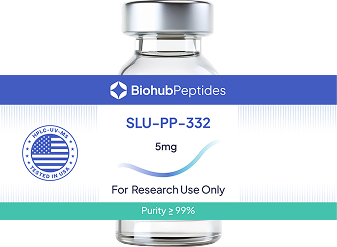
SLU-PP-332 is a synthetic small-molecule agonist of the estrogen-related receptor (ERR) family. It is not a peptide, but a naphthalene-modified compound developed from the GSK4716 scaffold. It activates all three ERR subtypes (ERRα, ERRβ, and ERRγ) with the highest potency at ERRα. The naphthalene moiety replaces the isopropyl group of GSK4716, creating π-π stacking interactions with Phe328 in the ERRα ligand-binding domain that improve receptor selectivity. ERRα is an orphan nuclear receptor and master regulator of mitochondrial biogenesis and cellular energy metabolism.
Chemical Information
- Chemical Name: SLU-PP-332 (4-Hydroxy-N-[(Z)-naphthalen-2-ylmethylideneamino]benzamide)
- Also Known As: SLU-PP-332
- Compound Class: Synthetic small-molecule pan-agonist of the estrogen-related receptor (ERR) family (ERRα/β/γ)
- Sequence: Not applicable. SLU-PP-332 is a small-molecule research compound, not a peptide
- Molecular Formula: C18H14N2O2
- Molecular Weight: 290.32 g/mol
- CAS Number: 303760-60-3
Applications
- Exercise-mimetic and ERR signaling research. SLU-PP-332 is a potent pan-agonist of the estrogen-related receptors (ERRα, ERRβ, ERRγ), with strongest activity at ERRα. It is used to study the induction of an acute aerobic exercise-like transcriptional program in skeletal muscle, including upregulation of genes such as Pdk4 in muscle cell models
- Mitochondrial biogenesis and cellular respiration research. Published work has shown that SLU-PP-332 enhances mitochondrial function and maximal cellular respiration in C2C12 muscle cell models. This supports its use in research on ERR-mediated mitochondrial biogenesis pathways
- Exercise capacity and skeletal muscle oxidative capacity research. In vivo work has examined repeated pharmacological ERR activation as a way to mimic training-induced adaptations in skeletal muscle oxidative capacity and exercise endurance, positioning SLU-PP-332 as a research tool for studying exercise mimetic pharmacology
- Cardiac metabolism and heart failure research. SLU-PP-332 has been studied alongside the related pan-ERR agonist SLU-PP-915 for effects on cardiac fatty acid metabolism and mitochondrial function in pressure-overload heart failure models, where ERR pan-agonism was found to improve cardiac pumping function without affecting hypertrophy
- Doping-detection and analytical chemistry research. Because ERR agonists including SLU-PP-332 have been investigated as potential exercise-mimetic doping agents, published work has characterized its in vitro metabolism and mass-spectrometric signature for anti-doping analytical purposes
Storage and Handling
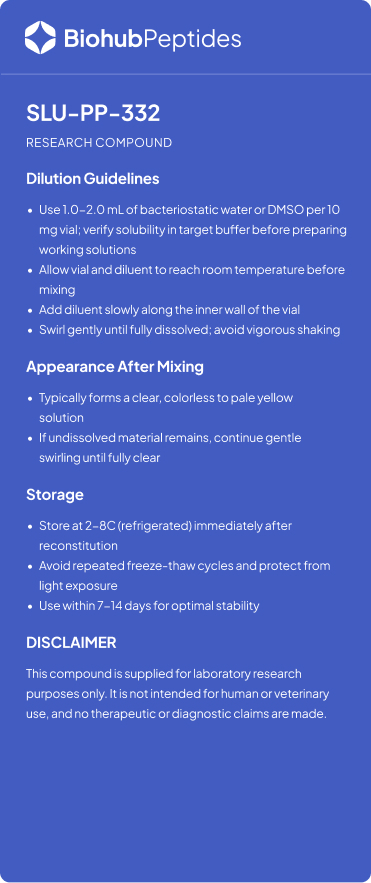
Store as a solid at room temperature or under refrigeration (2-8C) for extended stability, protected from heat, moisture, and direct light. For solution preparation, dissolve in an appropriate organic solvent (e.g., DMSO) as required by the experimental protocol; store working solutions at -20C and avoid repeated freeze-thaw cycles.
Compliance Notice
SLU-PP-332 is for laboratory research use only. They are not for human or veterinary use and carry no therapeutic, diagnostic, or clinical indication. FDA has not evaluated this product. By purchasing this product, the buyer confirms that they will follow appropriate institutional safety procedures and use it exclusively for controlled research.