Description
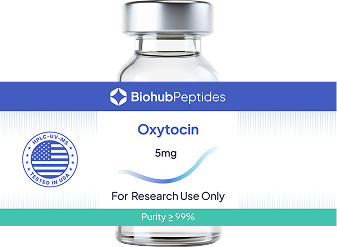
Oxytocin is a cyclic nonapeptide studied in controlled laboratory environments for its binding activity at oxytocin receptors (OXTRs) expressed across a range of tissue types, with research applications spanning neuroendocrine signaling, social behavior pathway modeling, and peripheral receptor pharmacology.
Chemical Information
- Chemical Name: Oxytocin (Cys-Tyr-Ile-Gln-Asn-Cys-Pro-Leu-Gly-NH2; nonapeptide)
- Also Known As: OXT; alpha-hypophamine; Pitocin (pharmaceutical oxytocin; not equivalent)
- Compound Class: Endogenous posterior pituitary nonapeptide; disulfide-bridged cyclic neuropeptide; pleiotropic neuromodulator
- Sequence: Cys-Tyr-Ile-Gln-Asn-Cys-Pro-Leu-Gly-NH2
- Molecular Formula: C43H66N12O12S2
- Molecular Weight: 1,007.2 g/mol
- CAS Number: 50-56-6
- Structural relationship to vasopressin: Oxytocin and vasopressin (AVP/ADH) are structural paralogs differing at positions 3 and 8; they share receptor cross-reactivity at high concentrations — a critical experimental design consideration
Applications
- OXTR Gq/11-coupled signaling studies in hypothalamic, limbic, and peripheral cell models. OXTR activation drives PLC/IP3/calcium mobilization; downstream effects include PKC activation, MAPK/ERK signaling, and receptor internalization through beta-arrestin recruitment; cell type-specific OXTR expression patterns (hypothalamic versus limbic versus peripheral immune) determine which signaling outcomes are observable in a given model
- Neuroendocrinoimmunology research. OXTR is expressed on T cells, B cells, macrophages, and dendritic cells; oxytocin modulates cytokine production profiles in immune cell models; the bidirectional neuroimmune communication — immune cells express OXTR and also produce oxytocin themselves — makes oxytocin relevant to models examining how the neuroendocrine and immune systems interact
- Oxytocin-vasopressin receptor cross-reactivity research. At the concentrations commonly used in cell-based assays, oxytocin can activate V1a and V1b vasopressin receptors, and vasopressin can activate OXTR; this cross-reactivity must be controlled for using selective antagonists (OXTR-selective: L-368,899; V1a-selective: SR-49059); researchers studying OXTR-specific signaling should include concentration-response curves and vasopressin receptor knockout controls in experimental designs
- HPG axis-oxytocin crosstalk research. OXTR expression in hypothalamic GnRH neurons and the direct modulation of GnRH release by oxytocin connects the posterior pituitary hormone to the HPG axis; the oxytocin-GnRH circuit interaction is studied in models examining how social and environmental stimuli affect reproductive neuroendocrine output through shared hypothalamic circuits
- Disulfide bridge pharmacology research. The Cys1-Cys6 disulfide forms a six-membered cyclic ring that positions the N-terminal Cys and positions 2-5 in the correct geometry for OXTR binding; linear oxytocin analogs with the disulfide reduced show dramatically reduced OXTR affinity; comparative binding studies using reduced versus oxidized forms characterize how the cyclic conformation contributes to receptor selectivity and binding affinity in SAR research designs
Storage and Handling
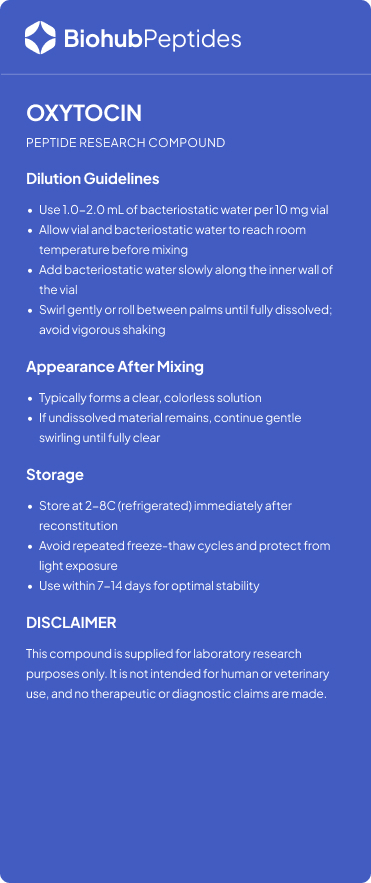
Store lyophilized powder at -20C for long-term stability, or at 2-8C for short-term use. Protect from heat, moisture, and direct light. Avoid reducing agents in reconstitution buffers. The Cys1-Cys6 disulfide bridge is required for OXTR binding geometry and is disrupted by DTT, beta-mercaptoethanol, and similar reducing conditions. Store reconstituted solutions at 2-8C and use promptly. Avoid repeated freeze-thaw cycles.
Compliance Notice
Oxytocin is for laboratory research use only. It is not for human or veterinary use and carries no therapeutic, diagnostic, or clinical indication. FDA has not evaluated this product. By purchasing this product, the buyer confirms that they will follow appropriate institutional safety procedures and use it exclusively for controlled research.