Description
Cagrilintide is a synthetic amylin analog peptide studied in controlled laboratory environments. It is frequently studied in parallel with GLP-1 receptor agonist peptides because the two signaling systems, amylin and GLP-1, are complementary rather than overlapping.
Chemical Information
- Chemical Name: Cagrilintide (AM833; NNC0174-0833)
- Also Known As: GLP-1 (C); AM833; NNC0174-0833
- Compound Class: Synthetic lipidated amylin analog; dual amylin and calcitonin receptor agonist (DACRA); non-selective AMYR+CTR agonist
- Molecular Formula: C194H312N54O59S2
- Molecular Weight: approximately 4,409 Da
- CAS Number: 1415456-99-3
- Key structural features: Five modifications from native amylin: 14E and 17R substitutions forming intramolecular salt bridge for alpha-helix stabilization; F23 residue enabling bypass binding mode at receptor transmembrane bundle; C-terminal P37 interaction; C20 fatty acid N-terminal lipidation for albumin binding; half-life approximately 159-195 hours (~7 days)
Applications
- RAMP-dependent amylin receptor subtype selectivity studies. Amylin receptors (AMY1R, AMY2R, AMY3R) are heterodimers of the calcitonin receptor (CTR) core with RAMP1, RAMP2, or RAMP3, respectively. Cagrilintide is a non-selective DACRA activating AMY1R, AMY2R, AMY3R, and CTR with comparable potency (established across 25 pharmacological endpoints, Fletcher et al. JPET 2021). HEK293 cells transfected with individual receptor complexes are the standard model for comparing cAMP responses and beta-arrestin recruitment across the four configurations
- Area postrema and nucleus tractus solitarius neuronal circuit research. The eBioMedicine 2025 RAMP1/RAMP3 knockout study confirmed that cagrilintide’s weight-regulatory effects depend specifically on AMY1R (RAMP1-containing) and AMY3R (RAMP3-containing) populations in the dorsal vagal complex. These structures express the highest CNS density of CALCR and RAMP subunits and represent the primary amylin circuit research territory
- Complementary amylin/GLP-1 receptor parallel pathway research. Amylin receptors in the area postrema and hypothalamic circuits operate independently of the nucleus tractus solitarius GLP-1R populations activated by semaglutide; cagrilintide provides the amylin receptor input for studying this anatomically distinct parallel-pathway architecture in neuroendocrine circuit models
- DACRA receptor balance studies. Comparative research between cagrilintide (balanced AMY1R/AMY3R/CTR non-selective) and CTR-biased DACRAs (such as KBP-336) enables study of whether receptor balance versus bias toward the calcitonin receptor alone changes the signaling and weight-regulatory outcomes; the receptor balance question is the central pharmacological research issue for the DACRA compound class
- Structural biology and bypass binding mode research. Bhatt et al. Nature Communications 2025 cryo-EM resolved cagrilintide bound to all four receptor targets simultaneously (AMY1R, AMY2R, AMY3R, CTR), with the F23 residue anchoring a bypass binding mode at the receptor transmembrane bundle level; this structural dataset provides reference data for studying how RAMP subunit identity affects extracellular domain positioning and ligand discrimination across the four configurations
Storage and Handling
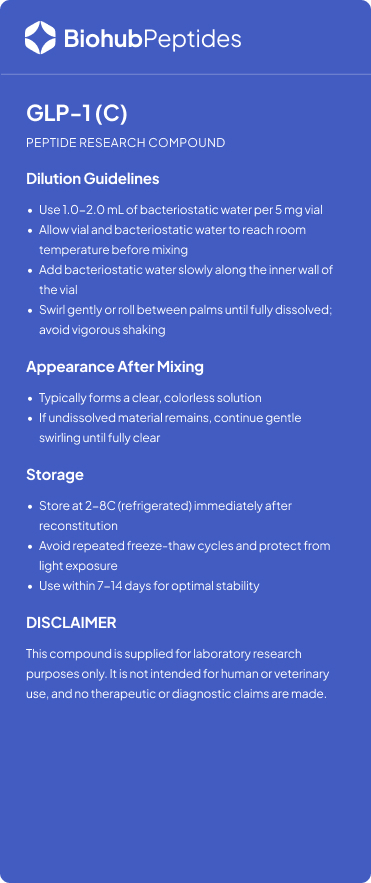
Store lyophilized powder at -20C for long-term stability, or at 2-8C for short-term use. Protect from heat, moisture, and direct light. Store reconstituted solutions at 2-8C and use promptly. Avoid repeated freeze-thaw cycles.
Compliance Notice
Cagrilintide is for laboratory research use only. It is not for human or veterinary use and carries no therapeutic, diagnostic, or clinical indication. This product has not been evaluated by the FDA. By purchasing this product, the buyer confirms that they will follow appropriate institutional safety procedures and use it exclusively for controlled research.