Description
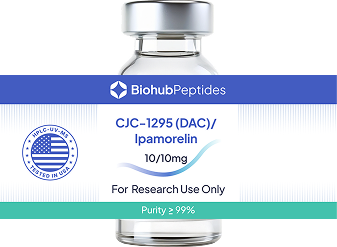
CJC-1295 DAC + Ipamorelin combines a long-acting GHRH analog with a selective ghrelin receptor agonist, studied for dual-pathway GH axis activation in models where sustained GHRH receptor background and simultaneous GHSR-1a stimulation are both experimental requirements. CJC-1295 DAC maintains GHRH receptor engagement for approximately 6–8 days through its albumin-binding Drug Affinity Complex. Ipamorelin activates GHSR-1a selectively through a Gq-coupled calcium cascade that operates independently of GHRH receptor input. Researchers use this combination when the experimental question involves how sustained GHRH axis stimulation interacts with episodic ghrelin receptor activation, or when a long-duration observation window makes repeated dosing with the no DAC + Ipamorelin blend impractical.
Chemical Information
- Chemical Name: CJC-1295 with DAC / Ipamorelin Blend
- CJC-1295 DAC Molecular Weight: approximately 3,647 Da; CAS 863288-34-0; half-life 5.8-8.1 days via covalent albumin conjugation
- Ipamorelin: Aib-His-D-2-Nal-D-Phe-Lys-NH2; Molecular Weight 711.9 g/mol; CAS 170851-70-4; no ACTH/cortisol co-stimulation
- Compound Class: Dual-pathway GH axis research blend; sustained-acting GHRHR agonist combined with selective GHSR-1a agonist
Applications
- Sustained GHRHR priming combined with pulsatile GHSR-1a triggering. CJC-1295 DAC provides continuous GHRHR occupancy for 6-8 days while Ipamorelin provides discrete GHSR-1a activation. The Ionescu and Frohman 2006 study found that pulsatile GH secretion is preserved even under continuous CJC-1295 DAC stimulation. Ipamorelin provides additional GHSR-1a triggers during each somatostatin withdrawal window, amplifying the natural GH pulse architecture rather than overriding it
- Comparison with no-DAC combination for GH pulse architecture research. Replacing CJC-1295 No DAC with CJC-1295 DAC in the same Ipamorelin combination changes only the GHRHR half-life while keeping receptor selectivity constant. This comparison isolates how sustained versus pulsatile GHRHR input affects the amplitude, shape, and periodicity of Ipamorelin-triggered GH pulses; a clean experimental comparison since no other variable changes
- Long-duration dual-pathway GH axis activation protocols. The 6-8 day CJC-1295 DAC half-life enables animal model studies requiring sustained dual-pathway GH axis activation without frequent GHRHR component dosing. Timing of Ipamorelin doses independently can characterize how pulsatile GHSR-1a input varies on a sustained GHRHR background
- Comparative IGF-1 elevation dynamics. Three conditions (CJC-1295 DAC alone, Ipamorelin alone, DAC/Ipamorelin combined) characterize how dual-receptor activation affects IGF-1 elevation time-course and magnitude relative to single-receptor activation. The sustained GHRHR background elevates the baseline IGF-1 floor against which Ipamorelin-triggered pulse contributions are measured
- Thiol buffer compatibility requirement. The CJC-1295 DAC component’s maleimide group requires thiol-free reconstitution and assay buffers. This is a blend-specific handling requirement that the CJC-1295 No DAC/Ipamorelin blend does not have
Storage and Handling
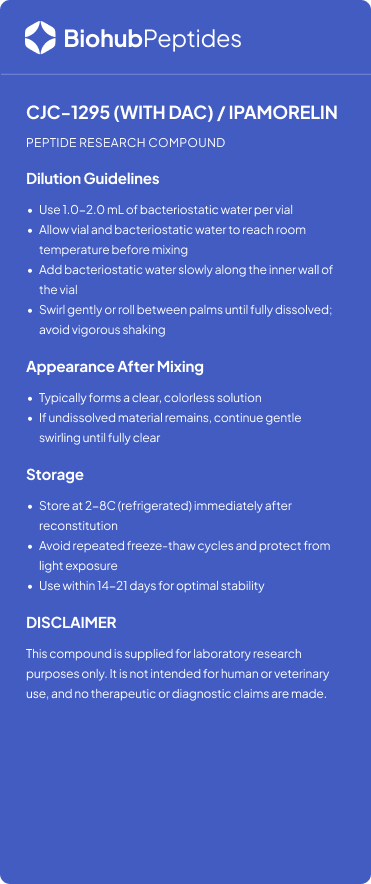
Store lyophilized blend at -20C for long-term stability, or at 2-8C for short-term use. Protect from heat, moisture, and direct light. Avoid thiol-containing buffers (DTT, beta-mercaptoethanol, cysteine, glutathione) due to the maleimide DAC group in the CJC-1295 DAC component. Store reconstituted solutions at 2-8C and use promptly. Avoid repeated freeze-thaw cycles.
Compliance Notice
CJC-1295 (With DAC)/Ipamorelin is for laboratory research use only. It is not for human or veterinary use and carries no therapeutic, diagnostic, or clinical indication. This product has not been evaluated by the FDA. By purchasing this product, the buyer confirms that they will follow appropriate institutional safety procedures and use it exclusively for controlled research.