Description
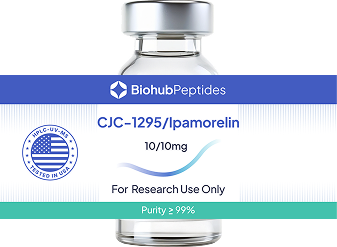
CJC-1295 no DAC + Ipamorelin is a peptide blend combining a short-acting GHRH analog with a ghrelin mimetic, studied in controlled laboratory environments for its dual-pathway activation of GHRH and ghrelin receptor signaling within the same experimental model. CJC-1295 no DAC engages the GHRH receptor with a half-life of approximately 30 minutes, producing a short, defined signaling window that mimics the pulsatile character of endogenous GHRH. Ipamorelin activates GHSR-1a through a Gq-coupled calcium cascade — a mechanistically independent route that, when combined with GHRH receptor input, allows researchers to study how dual-pathway stimulation influences GH pulse amplitude and timing. The blend is the primary tool for researchers asking questions about pulsatile GH release pattern research that neither compound can address individually.
Chemical Information
- Chemical Name: CJC-1295 (No DAC) / Ipamorelin Blend
- CJC-1295 No DAC sequence: Tyr-D-Ala-Asp-Ala-Ile-Phe-Thr-Gln-Ser-Tyr-Arg-Lys-Val-Leu-Ala-Gln-Leu-Ser-Ala-Arg-Lys-Leu-Leu-Gln-Asp-Ile-Leu-Ser-Arg-NH2
- CJC-1295 No DAC Molecular Formula: C152H252N44O42
- CJC-1295 No DAC Molecular Weight: approximately 3,368 Da
- CJC-1295 No DAC CAS: 446036-97-1
- Ipamorelin sequence: Aib-His-D-2-Nal-D-Phe-Lys-NH2
- Ipamorelin Molecular Formula: C38H49N9O5
- Ipamorelin Molecular Weight: 711.9 g/mol
- Ipamorelin CAS: 170851-70-4
- Compound Class: Dual-pathway GH axis research blend — short-acting GHRHR agonist combined with selective GHSR-1a agonist
Applications
- Dual-pathway GH pulse amplification studies. The mechanistic rationale is the somatotroph “primed and fire” model. CJC-1295 No DAC activates GHRHR via Gs-coupled cAMP/PKA, driving GH gene transcription, vesicle biogenesis, and voltage-gated calcium channel sensitization (priming). Ipamorelin activates GHSR-1a via Gq/11-coupled PLC/IP3/calcium release triggering vesicle exocytosis (firing). The two pathways address different rate-limiting steps in GH secretion and are mechanistically independent at the receptor level, producing GH pulse amplitudes exceeding either compound alone
- Four-condition experimental design research. CJC-1295 No DAC alone, Ipamorelin alone, combination, and vehicle control in the same somatotroph cell model quantifies each receptor pathway’s individual contribution and the additive relationship when both are simultaneously active
- Pulsatile GH secretion architecture studies. CJC-1295 No DACs ~30-minute half-life produces discrete receptor activation that clears between doses, preserving somatostatin-mediated GH pulse periodicity. Ipamorelin’s GHSR-1a selectivity (no ACTH, cortisol, or prolactin co-stimulation) means GH pulse amplification is attributable to the GHSR-1a pathway without glucocorticoid axis confounds
- Receptor dose-ratio studies. Comparing equimolar versus skewed GHRHR/GHSR-1a ratios in the same somatotroph model characterizes whether the two receptor systems produce strictly additive or synergistic GH secretion and which pathway is the rate-limiting input at different receptor occupancy levels
- Comparative pulsatile versus sustained dual-activation research. Replacing CJC-1295 No DAC with CJC-1295 DAC in the same Ipamorelin combination changes only the GHRHR half-life while keeping receptor selectivity identical. This comparison isolates how GHRHR activation duration affects the GHSR-1a-triggered exocytosis response
Storage and Handling
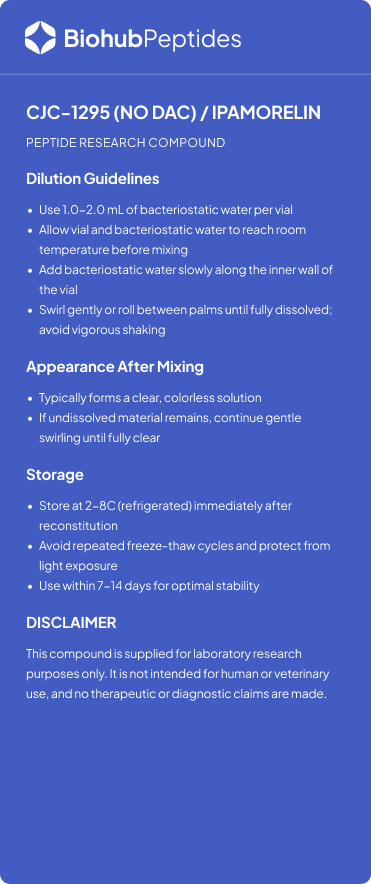
Store lyophilized blend at -20C for long-term stability, or at 2-8C for short-term use. Protect from heat, moisture, and direct light. Reconstituted solutions should be stored at 2-8C and used promptly. Avoid repeated freeze-thaw cycles.
Compliance Notice
CJC-1295 (No DAC)/Ipamorelin is for laboratory research use only. It is not for human or veterinary use and carries no therapeutic, diagnostic, or clinical indication. This product has not been evaluated by the FDA. By purchasing this product, the buyer confirms that they will follow appropriate institutional safety procedures and use it exclusively for controlled research.