Description
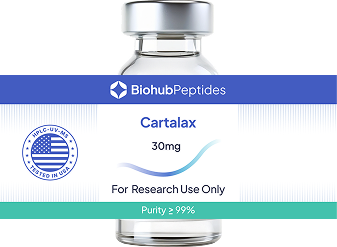
Cartalax is a synthetic short-chain peptide bioregulator that Professor Vladimir Khavinson developed at the St. Petersburg Institute of Bioregulation and Gerontology. It belongs to the same class of tissue-specific epigenetic regulators as Cardiogen, Epithalon, and Pinealon. Each targets a different cell type through the same intranuclear mechanism. Cartalax targets chondrocytes. It enters the cell nucleus and binds specific DNA promoter sequences, modulating the expression of genes that govern cartilage matrix synthesis and chondrocyte survival. Researchers studying short peptide DNA-binding mechanisms and tissue-specific gene regulation across the Khavinson series use Cartalax specifically in specialty research peptide cartilage biology models.
Chemical Information
- Chemical Name: Cartalax (Khavinson cartilage-targeted tetrapeptide bioregulator)
- Also Known As: Cartalax peptide complex
- Compound Class: Short-chain synthetic tetrapeptide; tissue-specific epigenetic bioregulator (Khavinson series)
- Sequence: Vendor and literature sources list varying sequences (AEDG, AEDL, AEDK) for Cartalax — confirm the specific sequence against the certificate of analysis before experimental use
- Molecular Formula: No data
- Molecular Weight: Not established in public literature (consistent with the broader Khavinson class of low molecular weight peptides, <10,000 Da)
- CAS Number: No data
Applications
- Chondrocyte-specific gene regulation research. Cartalax is modeled on cartilage tissue and acts via direct peptide-DNA interaction within chondrocyte nuclei rather than through cell-surface receptors. Preclinical data have reported modulation of COL2A1 (collagen type II), ACAN (aggrecan), and MMP expression in cartilage cell populations, consistent with an anabolic shift favoring matrix synthesis over degradation
- Apoptosis-suppression research in cartilage tissue. p53-mediated apoptosis suppression has been documented in preclinical cartilage models, paralleling the anti-apoptotic mechanism reported for Cardiogen in cardiac tissue — the same proposed epigenetic mechanism applied to a different target cell type
- Comparative joint-biology research alongside receptor-mediated tools. Cartalax is proposed to act at the gene-expression level rather than through growth-factor or angiogenic signaling. As a result, it is used alongside receptor-mediated cartilage and connective-tissue research, compounds such as BPC-157, to study complementary rather than overlapping mechanisms in joint biology
- Cross-tissue bioregulator specificity research. Cartalax shares its proposed DNA-interaction mechanism with other short-chain Khavinson peptides. Therefore, researchers use it alongside tissue-matched and mismatched bioregulators (e.g., Cardiogen for cardiac tissue, Cortagen for cerebral cortex) to study whether the effects observed are tissue-general or tissue-restricted
- Note on evidence base: All published evidence is preclinical and concentrated within the Khavinson research network. No independent Western clinical trials
Storage and Handling
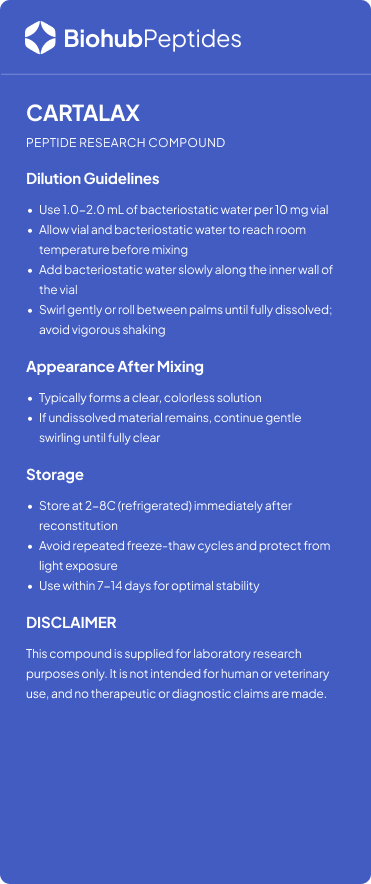
Store lyophilized powder under refrigeration (2-8C), protected from heat, light, and moisture. As a short-chain tetrapeptide, Cartalax is susceptible to proteolytic degradation once reconstituted. Store immediately before use, keep reconstituted solution refrigerated, and avoid repeated freeze-thaw cycles.
Compliance Notice
Cartalax is for laboratory research use only. It is not for human or veterinary use and carries no therapeutic, diagnostic, or clinical indication. This product has not been evaluated by the FDA. By purchasing this product, the buyer confirms they will use it exclusively for controlled research and that they will follow appropriate institutional safety procedures.