Description
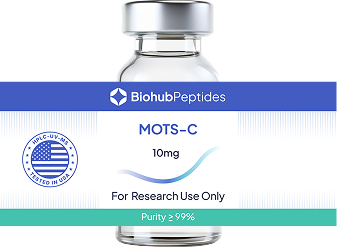
MOTS-C is a mitochondrial-derived signaling peptide encoded within mitochondrial DNA, studied in controlled laboratory environments for its role in retrograde signaling, metabolic regulation, and intracellular communication between mitochondria and the nucleus.
Chemical Information
- Chemical Name: MOTS-c (Mitochondrial Open Reading Frame of the 12S rRNA Type-C)
- Also Known As: MRWQEMGYIFYPRKLR; mitochondrial-derived peptide (MDP)
- Compound Class: Endogenous 16-amino acid mitochondrial-derived peptide; AMPK activator; retrograde mitochondrial-nuclear signaling molecule
- Sequence: Met-Arg-Trp-Gln-Glu-Met-Gly-Tyr-Ile-Phe-Tyr-Pro-Arg-Lys-Leu-Arg
- Molecular Weight: approximately 2,174 Da
Applications
- Folate-AICAR-AMPK pathway research. MOTS-c’s primary AMPK activation mechanism operates through folate cycle inhibition rather than direct AMPK binding; it inhibits de novo purine biosynthesis, causing AICAR (5-aminoimidazole-4-carboxamide ribonucleotide) accumulation, which phosphorylates and activates AMPK independently of cellular energy depletion. This is mechanistically distinct from metformin (complex I inhibition) and AICAR (direct AMPK activation), making MOTS-c the appropriate tool when the folate-to-AICAR pathway specifically is the experimental variable
- Mitochondrial-nuclear retrograde signaling research. The Lee et al. 2018 Cell Metabolism paper established that MOTS-c translocates to the nucleus in an AMPK-dependent manner under metabolic stress, binds ARE-containing gene promoters, and regulates antioxidant response element-linked gene programs including NRF2 activation. Nuclear translocation begins within 30 minutes of glucose restriction and returns to baseline within 24 hours; this stress-dependent nuclear import is the defining mechanistic feature distinguishing MOTS-c from simple AMPK activators
- Exercise-mitonuclear communication research. Endogenous MOTS-c levels rise 11.9-fold in skeletal muscle during exercise (Reynolds et al. 2021, Nature Communications); exogenous MOTS-c recapitulates exercise-induced AMPK activation and metabolic gene programs in sedentary animal models; researchers use this exercise-mimetic profile to study mitonuclear communication under conditions that model exercise adaptation without the confounds of actual physical activity
- Comparative mitochondrial-derived peptide research alongside Humanin and SHLP2. MOTS-c, Humanin, and SHLP peptides are all mitochondrially encoded but operate through distinct pathways: MOTS-c through folate-AICAR-AMPK and nuclear translocation; Humanin through Bax-mediated apoptosis inhibition and STAT3 activation; studying all three as a series characterizes how different mitochondrial-derived peptides coordinate organelle-to-nucleus communication under the same stress conditions
Storage and Handling
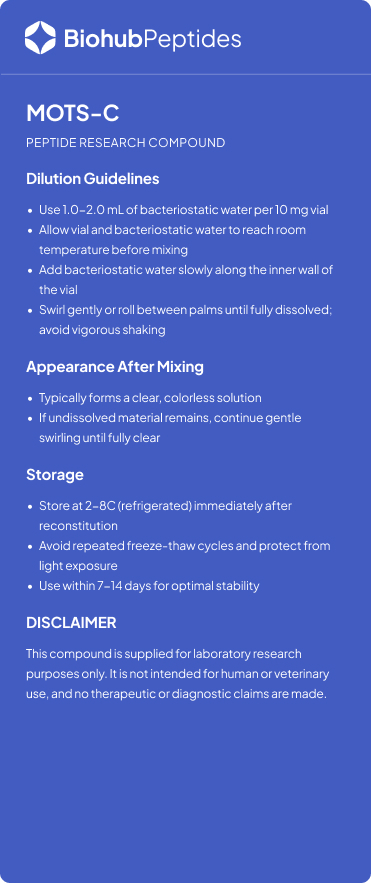
Store lyophilized powder at -20C for long-term stability, or at 2-8C for short-term use. Protect from heat, moisture, and direct light. Reconstituted solutions should be stored at 2-8C and used promptly. Avoid repeated freeze-thaw cycles.
Compliance Notice
MOTS-c is for laboratory research use only. It is not for human or veterinary use and carries no therapeutic, diagnostic, or clinical indication. FDA has not evaluated this product. By purchasing this product, the buyer confirms that they will follow appropriate institutional safety procedures and use it exclusively for controlled research.