
Description
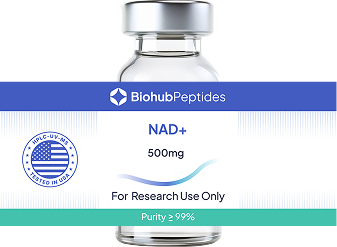
NAD+ (nicotinamide adenine dinucleotide) is a coenzyme studied in controlled laboratory environments for its central role in cellular energy metabolism, NAD+/NADH redox cycling, and mitochondrial signaling research. Although not classified as a peptide, it is frequently included in cellular signaling research categories alongside peptide compounds due to its involvement in energy-related biological systems.
Chemical Information
- Chemical Name: Nicotinamide adenine dinucleotide (oxidized form)
- Also Known As: NAD+; beta-NAD; coenzyme I; DPN (diphosphopyridine nucleotide, historical)
- Compound Class: Endogenous redox coenzyme and enzyme co-substrate (dinucleotide)
- Molecular Formula: C21H27N7O14P2
- Molecular Weight: 663.4 g/mol
- CAS Number: 53-84-9
Applications
- Sirtuin deacylase activity assays requiring NAD+ as the stoichiometric co-substrate. Enzymatic activity is directly dependent on NAD+ concentration, making this compound the rate-limiting reagent in sirtuin kinetics experiments
- PARP/sirtuin competition studies examining how NAD+ pool depletion under DNA damage conditions suppresses sirtuin activity. Well-characterized using PARP inhibitors as tools to probe the competitive relationship
- CD38 NADase activity research and calcium signaling studies. CD38 generates cADPR from NAD+, which drives ER calcium release through ryanodine receptors; CD38 inhibition is studied as a strategy to preserve NAD+ availability
- NAMPT salvage pathway research. NAMPT converts nicotinamide (the byproduct of all NAD+-consuming reactions) back to NMN, then NMNAT completes the cycle to NAD+; this pathway is the primary route for maintaining NAD+ homeostasis in mammalian cells
- NAD+/NADH ratio manipulation studies examining how oxidative versus reductive metabolic states affect downstream signaling. The ratio is a metabolic sensor for both energy status and redox state across glycolysis, TCA cycle, and OXPHOS
- Circadian clock research. NAD+ biosynthesis is controlled by CLOCK/BMAL1 transcription of NAMPT; SIRT1 in turn deacetylates BMAL1 in a feedback loop; timed NAD+ supplementation can phase-shift hepatic circadian oscillators in animal models
Storage and Handling
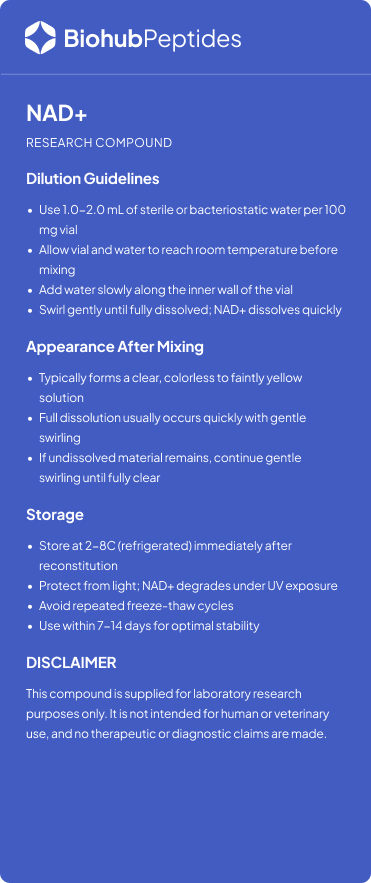
Store lyophilized powder at -20C for long-term stability, or at 2-8C for short-term use. Protect from light at all times. NAD+ is susceptible to UV-driven photodegradation. Reconstituted solutions should be stored at 2-8C and used promptly; NAD+ is also susceptible to hydrolytic degradation in aqueous solution. Avoid repeated freeze-thaw cycles and oxidizing conditions.
Compliance Notice
NAD+ is for laboratory research use only. It is not for human or veterinary use and carries no therapeutic, diagnostic, or clinical indication. FDA has not evaluated this product. By purchasing this product, the buyer confirms that they will follow appropriate institutional safety procedures and use it exclusively for controlled research.



