Description
AICAR is a cell-permeable adenosine analog and one of the most widely used pharmacological tools for studying AMP-activated protein kinase (AMPK) signaling in cellular and metabolic research. Once taken up by cells via adenosine transporters, it is phosphorylated by adenosine kinase to form ZMP, an AMP mimetic that binds the γ-subunit of AMPK. It activates it without altering the cellular ADP, ATP ratio or directly inhibiting mitochondrial function. This mechanism makes AICAR a useful tool for isolating AMPK-dependent signaling from the confounding metabolic effects that indirect AMPK activators typically introduce.
Chemical Information
- Chemical Name: AICAR (5-Aminoimidazole-4-carboxamide ribonucleotide; acadesine)
- Also Known As: Acadesine; AICA ribonucleotide; AICA riboside monophosphate; ZMP (its phosphorylated active form inside cells)
- Compound Class: Nucleotide analog; endogenous purine biosynthesis intermediate; cell-permeable AMPK activator (AMP mimetic)
- Molecular Formula: C9H14N4O8P
- Molecular Weight: 338.2 g/mol
- CAS Number: 2627-69-2
Applications
- AMPK activation research without energetic stress confound. AICAR activates AMPK through ZMP-mediated allosteric activation of the gamma-subunit without depleting cellular ATP. Experiments comparing AICAR-mediated AMPK activation versus metformin-mediated activation (which raises the AMP/ATP ratio) isolate the AMP-sensing mechanism from cellular energy status effects; the AICAR result represents pure AMP-mimetic AMPK allosteric activation. The metformin result conflates AMP-sensing with energetic stress
- PGC-1alpha upregulation and mitochondrial biogenesis research. AMPK phosphorylates and activates PGC-1alpha, the master regulator of mitochondrial biogenesis. AICAR-mediated AMPK activation drives PGC-1alpha-dependent mitochondrial gene programs including NRF1, TFAM, and electron transport chain subunit expression.
- GLUT4 translocation and glucose uptake research. AMPK activation by AICAR drives GLUT4 transporter translocation to the plasma membrane through AS160/TBC1D4 phosphorylation, enabling insulin-independent glucose uptake. The AICAR protocol is compared to insulin-stimulated GLUT4 translocation (PI3K/Akt pathway) and exercise-stimulated translocation (AMPK pathway) to characterize the three independent inputs to GLUT4 membrane localization
- Comparative AMPK activator research alongside MOTS-c. MOTS-c activates AMPK through folate cycle inhibition, causing AICAR accumulation; exogenous AICAR activates AMPK by delivering ZMP directly.
- De novo purine biosynthesis pathway research. AICAR is the endogenous substrate of ATIC (AICAR formyltransferase/IMP cyclohydrolase), the bifunctional enzyme catalyzing the last two steps of de novo purine biosynthesis. As such, researchers studying purine synthesis regulation use AICAR as both an endogenous intermediate reference and an exogenous substrate for ATIC activity assays. ATIC inhibition causes AICAR accumulation (endogenous), which is mechanistically how folate antagonists like methotrexate produce AMPK activation as a secondary effect
Storage and Handling
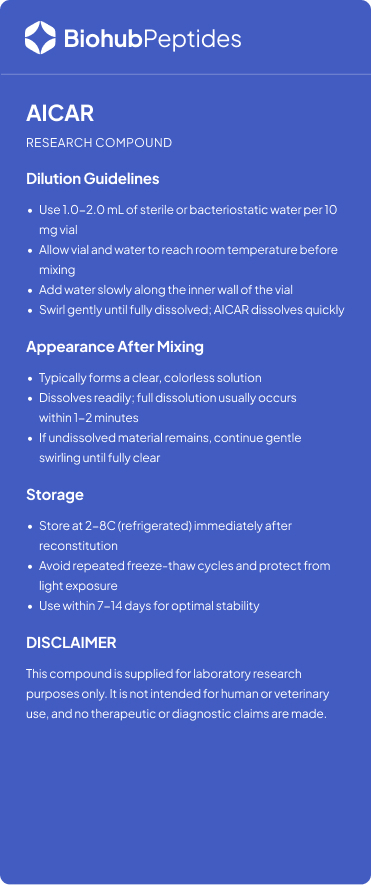
Store lyophilized powder at -20C for long-term stability, or at 2-8C for short-term use. Protect from heat, moisture, and direct light. AICAR dissolves readily in aqueous buffer. Store reconstituted solutions at 2-8C and used promptly. Avoid repeated freeze-thaw cycles.
Compliance Notice
AICAR is for laboratory research use only. It is not for human or veterinary use and carries no therapeutic, diagnostic, or clinical indication. This product has not been evaluated by the FDA. By purchasing this product, the buyer confirms it will use it exclusively for controlled research following appropriate institutional safety procedures.