Description
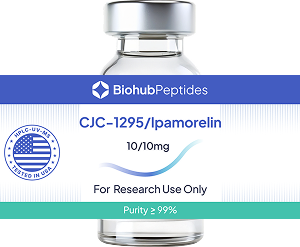
CJC-1295 with DAC is a modified GHRH analog built on the same 29-amino-acid backbone as the no DAC variant, with one critical addition. A Drug Affinity Complex (DAC) moiety is attached via a lysine-maleimide linker. After administration, the DAC component forms a covalent bond with cysteine-34 on serum albumin, effectively turning albumin into a slow-release depot for the peptide. The result is a half-life of approximately 6–8 days, compared to roughly 30 minutes for the no DAC format, and sustained GHRH receptor engagement across an extended observation window.
Chemical Information
- Chemical Name: CJC-1295 with DAC (DAC: GRF; tetrasubstituted GHRH 1-29 with Drug Affinity Complex)
- Also Known As: CJC-1295 DAC; DAC:GRF; long-acting GHRH analog
- Compound Class: Synthetic 30-amino acid GHRH analog with maleimidopropionyl-lysine DAC modification; albumin-binding long-acting GHRHR full agonist
- Sequence: Tyr-D-Ala-Asp-Ala-Ile-Phe-Thr-Gln-Ser-Tyr-Arg-Lys-Val-Leu-Ala-Gln-Leu-Ser-Ala-Arg-Lys-Leu-Leu-Gln-Asp-Ile-Leu-Ser-Arg-Lys(Maleimidopropionyl)-NH2
- Molecular Formula: C165H269N47O46
- Molecular Weight: approximately 3,647 Da
- CAS Number: 863288-34-0
- DAC modification: Maleimidopropionic acid (MPA) group on C-terminal lysine undergoes Michael addition reaction with Cys34 thiol on serum albumin; irreversible covalent thioether bond; over 90% binds albumin after SC injection (Teichman et al. 2006)
- Half-life: approximately 5.8-8.1 days (Teichman et al. 2006, J Clin Endocrinol Metab)
- Clinical data: Single SC dose produced GH increases of 2-10 fold sustained 6+ days; IGF-1 elevation 1.5-3 fold for 9-11 days; pulsatile GH architecture preserved (Ionescu and Frohman 2006)
Applications
- Sustained GHRHR activation research. CJC-1295 DAC’s 6-8 day half-life produces continuous GHRHR occupancy from a single dose; studying how sustained versus pulsatile GHRHR activation affects GHRHR expression levels, somatostatin feedback dynamics, GH pulse amplitude and shape, and IGF-1 production time-course requires the DAC variant for the sustained condition and Sermorelin or CJC-1295 No DAC for the pulsatile condition
- Albumin covalent bioconjugation mechanism research. The maleimide-Cys34 Michael addition creates an irreversible thioether bond distinct from the reversible fatty acid-mediated albumin binding used by semaglutide; the reaction chemistry, albumin binding specificity, and resulting pharmacokinetic consequences are well-characterized. CJC-1295 DAC serves as a reference model for studying covalent albumin bioconjugation as a peptide half-life extension strategy
- GHRHR desensitization under sustained receptor occupancy. Whether GHRHR upregulates (as documented for Sermorelin under pulsatile stimulation by Garcia et al. 2019) or desensitizes under continuous CJC-1295 DAC stimulation is a tractable research question. The distinct activation profiles of the DAC and No DAC variants provide the experimental conditions to answer it
- Long-duration IGF-1 elevation studies. The documented 9-11 day IGF-1 elevation from a single dose in human subjects (Teichman 2006) enables animal model protocols requiring sustained downstream GH axis activation without frequent dosing. The human pharmacodynamic data serve as a calibration reference for interpreting preclinical findings
- Maleimide DAC analytical detection research. Albumin-conjugated CJC-1295 DAC requires immunological detection or immunoaffinity enrichment prior to LC-HRMS/MS analysis. Traditional mass spectrometry methods for free peptides are inadequate for the protein-conjugated form. Researchers developing bioanalytical methods for DAC-modified peptides use CJC-1295 DAC as the reference compound for method validation
Storage and Handling
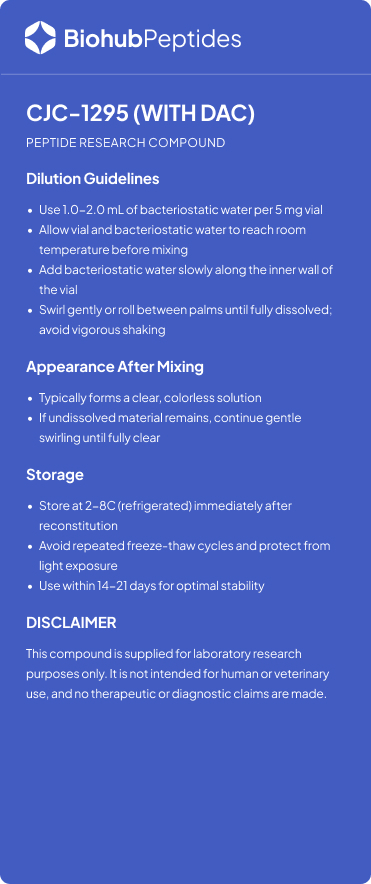
Store lyophilized powder at -20C for long-term stability, or at 2-8C for short-term use. Protect from heat, moisture, and direct light. The maleimide DAC group is susceptible to hydrolysis in solution and to reaction with thiol-containing compounds. Avoid DTT, beta-mercaptoethanol, cysteine, and glutathione in reconstitution and assay buffers. Store reconstituted solutions at 2-8C and use promptly. Avoid repeated freeze-thaw cycles.
Compliance Notice
CJC-1295 (DAC) is for laboratory research use only. It is not for human or veterinary use and carries no therapeutic, diagnostic, or clinical indication. This product has not been evaluated by the FDA. By purchasing this product, the buyer confirms that they will follow appropriate institutional safety procedures and use it exclusively for controlled research.