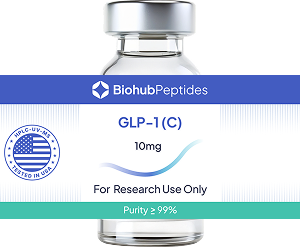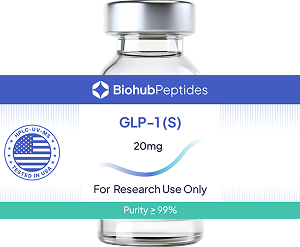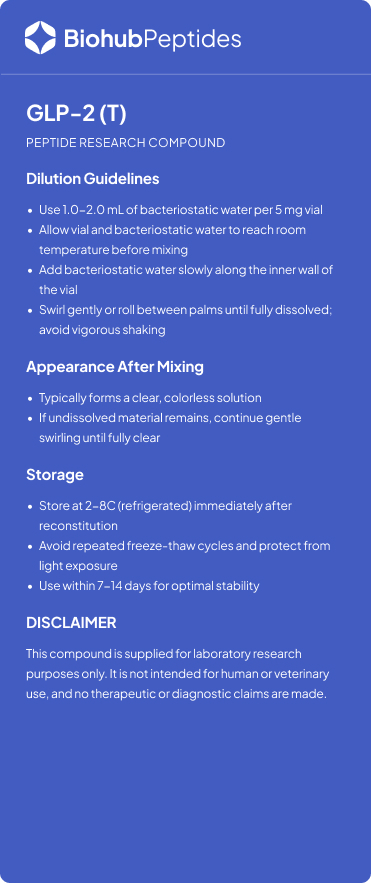
Description
Tirzepatide is a synthetic dual incretin receptor agonist studied in controlled laboratory environments for its ability to activate both GLP-1 and GIP receptors simultaneously, allowing researchers to observe combined signaling behavior within a single model. Adding GIP receptor activity to GLP-1R engagement is what distinguishes Tirzepatide from single-pathway GLP-1 receptor agonist peptides in research models
Chemical Information
- Chemical Name: Tirzepatide (LY3298176; dual GIP/GLP-1 receptor agonist)
- Also Known As: GLP-2 (T); Mounjaro; Zepbound (research-grade compound is not equivalent to any approved formulation)
- Compound Class: Synthetic dual incretin receptor agonist; imbalanced and biased GIP-R/GLP-1R co-agonist
- Molecular Formula: C225H348N48O68
- Molecular Weight: approximately 4,813 Da
- CAS Number: 2023788-19-2
- Key structural features: Aib substitutions at positions 2 and 13 (DPP-4 resistance); C20 fatty diacid chain enabling albumin binding and once-weekly half-life; 39-amino acid sequence with 14 GIP-derived residues
- FDA Status: Approved as Mounjaro (type 2 diabetes) and Zepbound (weight management)
Applications
- Biased agonism characterization at GLP-1R. Tirzepatide is an imbalanced and biased dual agonist (Willard et al., JCI Insight 2020). At GLP-1R, it favors cAMP generation over beta-arrestin recruitment, reducing GLP-1R internalization compared to native GLP-1 and semaglutide. Beta-arrestin1 knockout in beta cells increases GLP-1R-activated insulin secretion, confirming that tirzepatide’s bias away from beta-arrestin1-mediated signal termination contributes to its insulin secretagogue profile beyond simple dual receptor co-activation
- Imbalanced dual receptor occupancy research. At clinical doses, tirzepatide engages GIPR more than GLP-1R; this asymmetric occupancy creates a defined experimental condition for studying simultaneous incretin receptor activation at different receptor densities
- GIPR full agonism studies. Tirzepatide’s activity at GIPR closely mimics native GIP (EC50 approximately 22.4 pM versus 33.4 pM for native GIP) without the biased agonism profile seen at GLP-1R, making it a well-characterized GIPR reference agonist for pancreatic islet and adipose tissue cell models
- Receptor internalization trafficking studies. The reduced GLP-1R internalization relative to semaglutide and GLP-1 makes tirzepatide a tool for studying how biased agonism affects receptor trafficking through Rab5+/Rab7+ endosomal compartments and signaling duration in GLP-1R-expressing cell lines
- Comparative incretin receptor pharmacology series. Tirzepatide (biased GIPR-dominant dual agonist) alongside semaglutide (GLP-1R monoagonist) and retatrutide (GLP-1R/GIP-R/GCGR triple agonist) enables systematic study of how incremental receptor complexity changes metabolic signaling outcomes in the same cell model
- Cryo-EM structural pharmacology research. PNAS 2022 resolved tirzepatide bound to GLP-1R and GIPR in complex with Gs; the distinct conformational dynamics at each receptor provide structural reference data for studying how a single ligand achieves pharmacologically distinct activation profiles at two homologous Class B GPCRs
Storage and Handling
Store lyophilized powder at -20C for long-term stability, or at 2-8C for short-term use. Protect from heat, moisture, and direct light. As a lipidated peptide, tirzepatide’s fatty diacid chain can interact with certain buffer components; avoid detergent-containing reconstitution buffers. Reconstituted solutions should be stored at 2-8C and used promptly. Avoid repeated freeze-thaw cycles.
Compliance Notice
Tirzepatide is for laboratory research use only. It is not for human or veterinary use and carries no therapeutic, diagnostic, or clinical indication. FDA approved tirzepatide as Mounjaro and Zepbound. However, the research-grade compound is not equivalent to any approved pharmaceutical formulation and is not manufactured under GMP conditions. By purchasing this product, the buyer confirms that they will follow appropriate institutional safety procedures and use it exclusively for controlled research.