Description
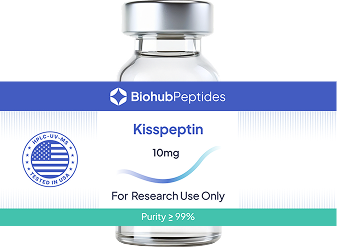
Kisspeptin is a neuropeptide studied in controlled laboratory environments for its role as a potent activator of the KISS1R receptor (GPR54), a signaling pathway closely associated with the regulation of gonadotropin-releasing hormone (GnRH) activity in neuroendocrine research models.
Chemical Information
- Chemical Name: Kisspeptin-10 (KP-10; C-terminal decapeptide of Kisspeptin-54)
- Also Known As: KP-10; metastin fragment; KISS1 gene product decapeptide
- Compound Class: Endogenous neuropeptide (C-terminal active fragment of Kisspeptin-54; KISS1 gene product)
- Sequence: Tyr-Asn-Trp-Asn-Ser-Phe-Gly-Leu-Arg-Phe-NH2
- Molecular Formula: C63H83N15O13
- Molecular Weight: 1,302.5 g/mol
- CAS Number: 374683-27-9
- Receptor: KISS1R (GPR54) — Gq/11-coupled GPCR; Kisspeptin-10 is the minimal active fragment with full KISS1R agonist activity
- HPG axis position: Upstream of GnRH neurons; KNDy neurons in hypothalamic arcuate nucleus co-express kisspeptin, neurokinin B (NKB), and dynorphin (Dyn) — the KNDy peptide triad that generates GnRH pulse rhythmicity
Applications
- KISS1R (GPR54) activation studies in hypothalamic GnRH neuron models. Kisspeptin-10 provides the minimal sequence with full KISS1R agonist activity; Gq/11-coupled PLC/IP3/calcium mobilization downstream of KISS1R drives GnRH neuron depolarization and GnRH release; researchers studying KISS1R pharmacology use Kisspeptin-10 as the reference agonist in calcium imaging and cAMP/IP3 accumulation assays
- KNDy neuron circuit biology research. The KNDy (Kisspeptin-Neurokinin B-Dynorphin) neuron population in the arcuate nucleus is the primary generator of GnRH pulse rhythmicity; kisspeptin provides the excitatory GnRH-releasing signal, NKB amplifies kisspeptin release through auto-facilitation, and dynorphin provides pulsatile termination of each GnRH burst. Kisspeptin-10 enables selective activation of the kisspeptin arm of this circuit independently of NKB and dynorphin
- Gonadal steroid negative feedback integration research. Estrogen receptor alpha (ERalpha) on kisspeptin neurons in the arcuate nucleus mediates the primary negative feedback signal that reduces GnRH pulse frequency under high estrogen conditions; kisspeptin neurons are the intermediary between peripheral gonadal steroid status and central GnRH pulse generation. Kisspeptin-10 is the tool for studying how steroid feedback modulates kisspeptin neuron excitability and output
- Comparative HPG axis entry point research. Kisspeptin-10 (hypothalamic entry, upstream of GnRH neurons) versus Gonadorelin (pituitary entry, at GnRH receptor on gonadotroph cells) versus LH/FSH (gonadal entry) enables systematic study of how HPG axis activation at different levels affects downstream gonadal steroid output in preclinical models; this hierarchical comparison is particularly useful in models studying HPG axis dysfunction
- Species-specific KISS1R pharmacology research. Kisspeptin receptor sensitivity varies across species; rodent KISS1R and human KISS1R display different affinities for kisspeptin variants. Kisspeptin-10 (the conserved C-terminal decapeptide) is the appropriate cross-species reference compound for comparative receptor pharmacology studies because the C-terminal RF-amide motif is conserved across mammalian species
Storage and Handling
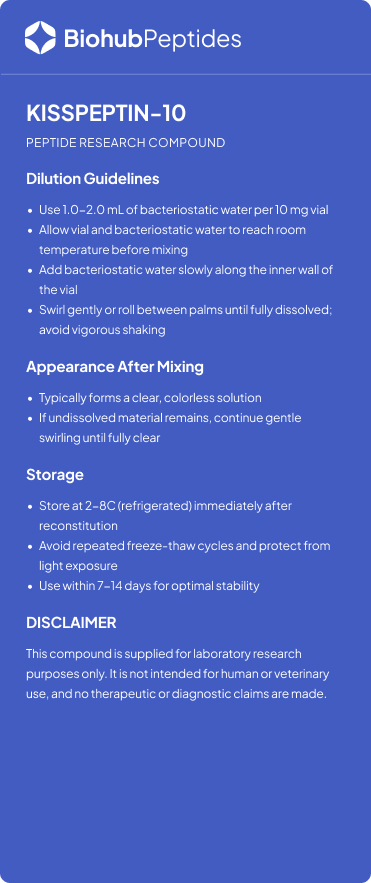
Store lyophilized powder at -20C for long-term stability, or at 2-8C for short-term use. Protect from heat, moisture, and direct light. Reconstituted solutions should be stored at 2-8C and used promptly. Avoid repeated freeze-thaw cycles.
Compliance Notice
Kisspeptin-10 is for laboratory research use only. It is not for human or veterinary use and carries no therapeutic, diagnostic, or clinical indication. This product has not been evaluated by the FDA. By purchasing this product, the buyer confirms that they will follow appropriate institutional safety procedures and use it exclusively for controlled research.