Description
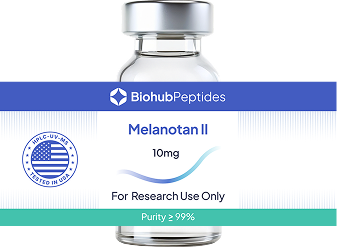
Melanotan-2 is a synthetic cyclic heptapeptide studied in controlled laboratory environments for its broad agonist activity across multiple melanocortin receptor subtypes (MC1R through MC5R), making it a useful tool in research models examining pigmentation signaling, receptor selectivity, and related downstream pathways.
Chemical Information
- Chemical Name: Melanotan II (cyclo[Nle4, Asp5, D-Phe7]-alpha-MSH(4-11); MT-II)
- Also Known As: MT-II; MTII; cyclic alpha-MSH analog
- Compound Class: Synthetic cyclic melanocortin receptor pan-agonist (MC1R, MC3R, MC4R, MC5R); POMC-derived peptide family analog
- Molecular Formula: C50H69N15O9
- Molecular Weight: 1,024.2 g/mol
- CAS Number: 121062-08-6
Applications
- MC1R activation and melanogenesis research in melanocyte cell models. MC1R on melanocytes is the primary receptor governing melanin synthesis; Melanotan II activates the MC1R-driven Gs-cAMP-PKA-CREB cascade that upregulates MITF transcription factor and downstream melanogenic enzyme expression (tyrosinase, TRP-1, TRP-2); radioligand competition assays using 125I-NDP-alpha-MSH as the tracer establish Melanotan II binding affinity at MC1R in transfected cell lines
- MC4R hypothalamic circuit research. MC4R is expressed in the paraventricular nucleus (PVN) and other hypothalamic populations where it regulates autonomic nervous system output. Melanotan II’s MC4R activation drives Gs-cAMP signaling in these populations. The MC3R/MC4R co-activation by Melanotan II is mechanistically distinct from PT-141’s selective MC3R/MC4R profile because MC3R has a distinct anatomical distribution (arcuate nucleus, energy balance circuits) from MC4R (PVN, autonomic output)
- MC3R energy homeostasis research. MC3R is expressed in arcuate nucleus neurons where it regulates feed efficiency and energy partitioning. MC3R knockout mice develop obesity with altered feed efficiency but not hyperphagia (distinct from MC4R knockouts, which are hyperphagic)
- POMC pathway pharmacology research. The His-Phe-Arg-Trp core sequence of Melanotan II is conserved across POMC-derived melanocortin peptides (alpha-MSH, beta-MSH, gamma-MSH). SAR studies use Melanotan II as a reference non-selective agonist when examining how structural variation around this pharmacophore core affects receptor subtype selectivity across the melanocortin receptor family
- AgRP antagonism research. Agouti-related protein (AgRP) is the endogenous inverse agonist at MC3R and MC4R produced by AgRP/NPY neurons in the arcuate nucleus. AgRP and POMC neurons are anatomically adjacent and functionally opposed. Melanotan II in competitive displacement assays with AgRP characterizes the AgRP/agonist competition at MC3R/MC4R. As such, researches use it in models studying how the endogenous agonist-antagonist balance at neural melanocortin receptors determines circuit output
Storage and Handling
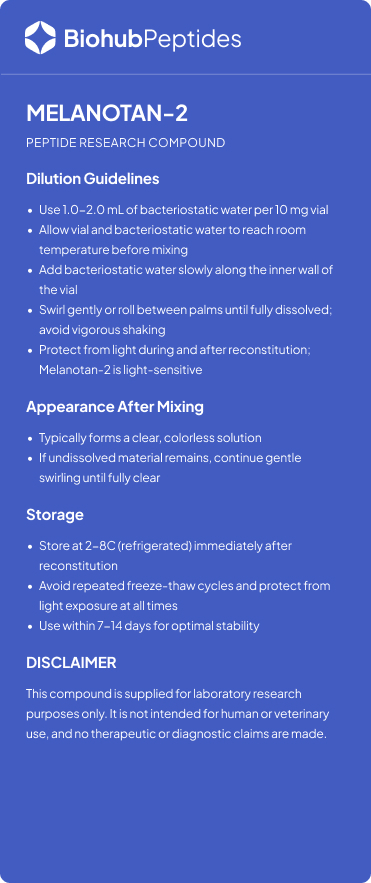
Store lyophilized powder at -20C for long-term stability, or at 2-8C for short-term use. Protect from light at all times. Melanotan II is light-sensitive. Store reconstituted solutions at 2-8C, protected from light, and use promptly. Avoid repeated freeze-thaw cycles.
Compliance Notice
Melanotan II is for laboratory research use only. It is not for human or veterinary use and carries no therapeutic, diagnostic, or clinical indication. FDA has not evaluated this product. By purchasing this product, the buyer confirms that they will follow appropriate institutional safety procedures and use it exclusively for controlled research.