Description
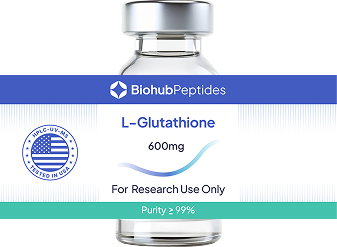
L-Glutathione is a naturally occurring tripeptide studied in controlled laboratory environments for its central role in cellular redox homeostasis, oxidative stress pathway research, and enzymatic antioxidant system modeling, including its function as the primary substrate for glutathione peroxidase and glutathione S-transferase activity.
Chemical Information
- Chemical Name: L-Glutathione (reduced form; gamma-L-glutamyl-L-cysteinylglycine; GSH)
- Also Known As: GSH; reduced glutathione; gamma-glutamylcysteinylglycine
- Compound Class: Endogenous tripeptide antioxidant and redox signaling molecule; most abundant intracellular thiol in mammalian cells
- Sequence: gamma-Glu-Cys-Gly (note: gamma-peptide bond at glutamate N-terminus — atypical bond formed by glutamate’s gamma-carboxyl group rather than the alpha-carboxyl; this isopeptide bond protects against degradation by conventional aminopeptidases)
- Molecular Formula: C10H17N3O6S
- Molecular Weight: 307.3 g/mol
- CAS Number: 70-18-8
- Key chemical property: Free thiol on cysteine residue is the redox-active moiety; oxidized to glutathione disulfide (GSSG) under oxidative conditions; the GSH/GSSG ratio is a primary indicator of cellular redox state
- Intracellular concentration: 1-10 mM in most mammalian cells — among the highest concentrations of any biological small molecule
Applications
- Cellular redox state manipulation research. The GSH/GSSG ratio is the primary intracellular redox buffer. Exogenous L-Glutathione supplementation in cell culture raises the GSH/GSSG ratio and shifts cells toward a more reduced state. Experiments manipulating this ratio using exogenous GSH alongside BSO (glutathione synthesis inhibitor) and diamide (thiol oxidant) characterize how specific redox states affect downstream signaling in models of oxidative stress, apoptosis, and metabolic regulation
- Glutathione peroxidase (GPx) and glutathione reductase (GR) enzyme activity research. GSH is the stoichiometric substrate for GPx-mediated H2O2 and lipid hydroperoxide reduction. Each catalytic cycle consumes one GSH and produces GSSG. GR then restores GSH from GSSG using NADPH; the coupled GPx/GR system is the primary enzymatic H2O2 detoxification pathway in most mammalian cells. Exogenous L-Glutathione provides the substrate for characterizing GPx kinetics and GR-mediated regeneration capacity
- Protein S-glutathionylation research. The free thiol of protein cysteine residues can form mixed disulfides with GSH (protein-SSG) under oxidative conditions; protein S-glutathionylation reversibly modifies enzyme activity, receptor function, and transcription factor binding; L-Glutathione provides both the physiological S-glutathionylation substrate and the reducing agent for deglutathionylation by glutaredoxin; researchers studying redox-regulated protein function use exogenous GSH to manipulate S-glutathionylation stoichiometry in cell-free and cell-based systems
- Mitochondrial GSH research. The mitochondrial matrix maintains its own GSH pool (mGSH) transported from the cytoplasm via the dicarboxylate and oxoglutarate carriers; mGSH is the primary defense against mitochondrial ROS; L-Glutathione in cell culture experiments can preferentially restore mGSH under conditions where mitochondrial import capacity is limiting; experiments examining how mGSH depletion versus cytoplasmic GSH depletion differentially affects mitochondrial function characterize the distinct roles of the two compartmental GSH pools
Storage and Handling
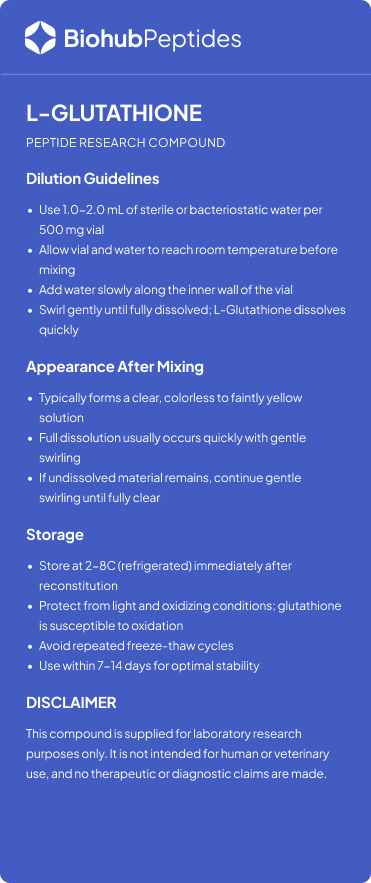
Store lyophilized powder at -20C for long-term stability, or at 2-8C for short-term use. Protect from light and oxidizing conditions at all times — L-Glutathione is susceptible to oxidation via the free cysteine thiol. Reconstituted solutions should be prepared fresh and used promptly; oxidation begins upon air exposure. Avoid oxygen-containing reconstitution buffers where possible. Avoid repeated freeze-thaw cycles.
Compliance Notice
L-Glutathione is for laboratory research use only. It is not for human or veterinary use and carries no therapeutic, diagnostic, or clinical indication. This product has not been evaluated by the FDA. By purchasing this product, the buyer confirms that they will follow appropriate institutional safety procedures and use it exclusively for controlled research.