Description
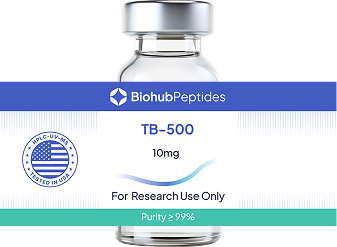
TB-500 is a synthetic peptide studied in controlled laboratory environments for its association with broader tissue interaction, cellular movement processes, and cytoskeletal signaling behavior across multiple tissue areas.
Chemical Information
- Chemical Name: TB-500 (Thymosin Beta-4 actin-binding fragment; Ac-LKKTETQ)
- Also Known As: Thymosin Beta-4 active fragment; Tβ4 WH2 motif heptapeptide; TB4 fragment
- Compound Class: Synthetic N-terminally acetylated heptapeptide; G-actin sequestering peptide (WH2 motif of Thymosin Beta-4)
- Sequence: Ac-Leu-Lys-Lys-Thr-Glu-Thr-Gln (residues 17-23 of full 43-amino acid Thymosin Beta-4)
- Molecular Weight: approximately 882 Da
- Actin binding: 1:1 stoichiometry with G-actin monomers; Kd approximately 0.5-0.7 micromolar; capping both ends prevents incorporation into F-actin
Applications
- G-actin sequestration and actin polymerization dynamics research. TB-500 binds G-actin monomers through the LKKTETQ WH2 domain, preventing barbed-end incorporation into F-actin; X-ray crystallography of a gelsolin-domain-1/Tβ4 hybrid at 2 Angstrom resolution confirmed 1:1 complex stoichiometry and dual-end capping. G-actin/F-actin ratio measurements by ultracentrifugation fractionation, DNase I inhibition assay, or pyrene-actin fluorescence polymerization assay establish the quantitative relationship between TB-500 concentration and G-actin pool size
- Directed cell migration research. The actin-sequestering activity controls G-actin availability for barbed-end polymerization at lamellipodia and filopodia; lysine residues at positions 2 and 3 of LKKTETQ contribute electrostatic interactions with negatively charged actin monomer surfaces. Threonine and glutamic acid contribute additional stabilizing contacts at subdomains 1 and 4. Scratch wound assays and transwell migration assays with jasplakinolide or latrunculin controls characterize how TB-500-mediated G-actin pool management affects migration velocity and directionality
- ILK/Akt survival signaling research. The Bock-Marquette et al. 2004 Nature paper identified integrin-linked kinase (ILK) activation and downstream Akt phosphorylation as a mechanistically distinct Tβ4 pathway beyond actin sequestration. TB-500’s short sequence simplifies dissection of which structural features drive ILK interaction versus actin binding, enabling experiments that isolate the two mechanistic axes
- Full-length Tβ4 versus TB-500 fragment comparative research. Whether the heptapeptide fragment reproduces the full spectrum of full-length Tβ4 activity is the foundational research question for TB-500 biology. Most published wound, cardiac, and tissue repair studies used full-length Tβ4, not the fragment.
- Actin-dependent angiogenesis research. Endothelial tube formation during angiogenesis requires directed migration and cytoskeletal organization driven by leading-edge actin dynamics. TB-500 as a G-actin pool modulator provides a mechanistic approach to studying how actin availability limits or enables angiogenic endothelial behavior, complementary to VEGFR2-mediated approaches and providing the cytoskeletal axis component in BPC-157/TB-500 combination research designs
Storage and Handling
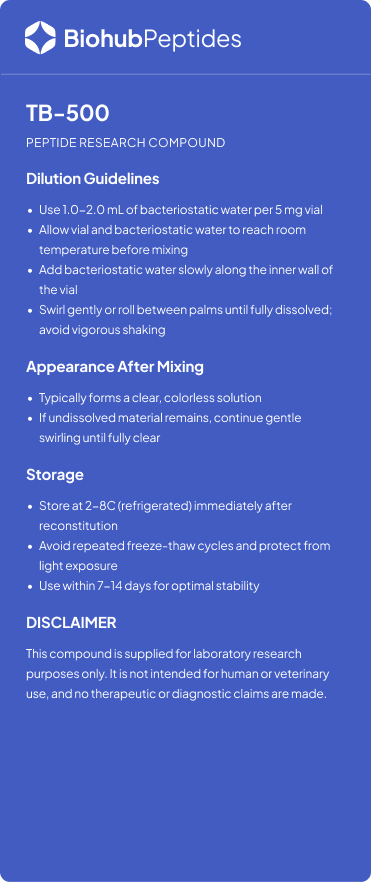
Store lyophilized powder at -20C for long-term stability, or at 2-8C for short-term use. Protect from heat, moisture, and direct light. Reconstituted solutions should be stored at 2-8C and used promptly. Avoid repeated freeze-thaw cycles.
Compliance Notice
TB-500 is for laboratory research use only. They are not for human or veterinary use and carry no therapeutic, diagnostic, or clinical indication. FDA has not evaluated this product. By purchasing this product, the buyer confirms that they will follow appropriate institutional safety procedures and use it exclusively for controlled research.