Description
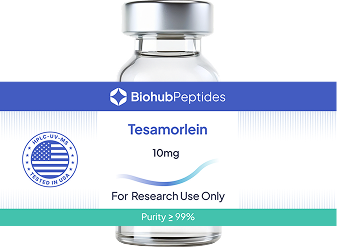
Tesamorelin is a structurally modified GHRH analog peptide studied in controlled laboratory environments for its extended signaling profile and interaction with growth hormone pathways over longer observation windows.
Chemical Information
- Chemical Name: Tesamorelin (trans-3-hexenoic acid-GHRH(1-44)-NH2; TH9507)
- Also Known As: TH9507; Egrifta (research-grade compound is not equivalent to the approved pharmaceutical formulation)
- Compound Class: Synthetic full-length GHRH analog with N-terminal DPP-4-protective modification; long-acting GHRHR full agonist
- Molecular Weight: approximately 5,136 Da
- CAS Number: 218949-48-9
- Key structural features: Full 44-amino acid native GHRH sequence (C-terminal extension beyond sermorelin’s 29 AA); trans-3-hexenoic acid at N-terminus blocking DPP-4 cleavage of Tyr-Ala site; internal cleavage sites at Leu14-Gly15 and Lys21-Lys22 remain unprotected; plasma half-life approximately 26-38 minutes SC
- FDA Status: Approved as Egrifta for HIV-associated lipodystrophy
Applications
- DPP-4 resistance mechanism research at the N-terminal cleavage site. The trans-3-hexenoic acid group sterically blocks DPP-4 access to the Tyr-Ala cleavage site without disrupting GHRHR binding pocket engagement (tesamorelin retains full GHRHR agonist activity while gaining approximately two-fold DPP-4 resistance); comparing tesamorelin (N-terminal protected only) with CJC-1295 No DAC (internal amino acid substitutions providing broader proteolytic resistance) dissects which enzymatic cleavage sites most determine half-life and in vitro stability
- Extended-duration GHRHR activation research. Tesamorelin’s 26-38 minute half-life versus sermorelin’s 11-12 minutes produces an intermediate receptor engagement window; paired experiments using sermorelin (short), tesamorelin (intermediate), CJC-1295 No DAC (30 minutes), and CJC-1295 DAC (6-8 days) characterize how activation duration affects GHRHR signaling amplitude, somatostatin feedback kinetics, and pituitary GH secretory dynamics
- GHRHR full-length sequence versus minimal fragment pharmacology. Tesamorelin’s complete 44-amino acid sequence versus sermorelin’s 29-amino acid truncation provides the experimental pair for studying what the C-terminal GHRH residues (30-44) contribute to GHRHR binding affinity, receptor contact surface area, and sustained signaling; the half-life difference (11-12 minutes sermorelin versus 26-38 minutes tesamorelin) is partly attributable to this additional receptor contact
- Visceral adipose tissue biology research. The Egrifta approval dataset established that tesamorelin-driven GHRH-axis activation reduces visceral adipose tissue in a manner pharmacologically separable from GH’s direct somatotropic effects; preclinical adipocyte and fat depot models use tesamorelin to probe how GHRH-axis stimulation specifically affects visceral adipose tissue gene programs including lipid oxidation, lipolysis regulation, and adipokine expression
Storage and Handling
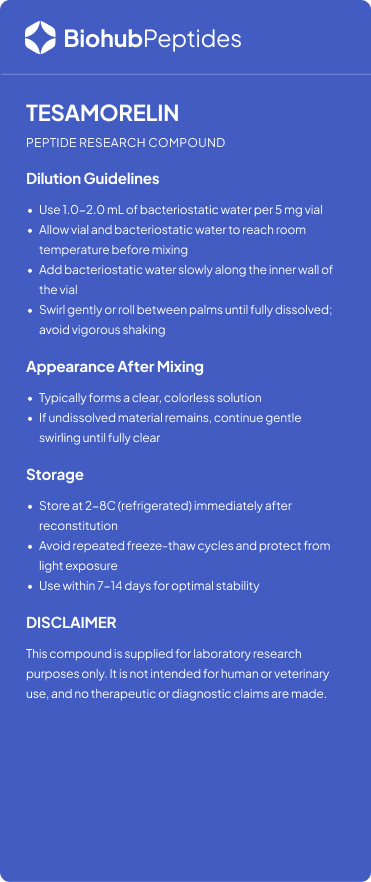
Store lyophilized powder at -20C for long-term stability, or at 2-8C for short-term use. Protect from heat, moisture, and direct light. The trans-3-hexenoic acid N-terminal modification improves DPP-4 resistance, but internal endopeptidase cleavage sites at Leu14-Gly15 and Lys21-Lys22 remain unprotected. Store reconstituted solutions at 2-8C and use promptly. Avoid repeated freeze-thaw cycles.
Compliance Notice
Tesamorelin is for laboratory research use only. They are not for human or veterinary use and carry no therapeutic, diagnostic, or clinical indication. Tesamorelin is FDA-approved as Egrifta for HIV-associated lipodystrophy. However, this research-grade compound is not equivalent to the approved pharmaceutical formulation and is not manufactured under GMP conditions. FDA has not evaluated this product. By purchasing this product, the buyer confirms that they will follow appropriate institutional safety procedures and use it exclusively for controlled research.