Description
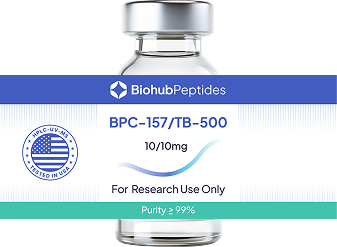
The BPC-157 + TB-500 peptide blend combines two distinct research compounds into a single dual-pathway model, studied in controlled laboratory environments to observe how localized tissue signaling associated with BPC-157 and broader tissue interaction linked to TB-500 behave within the same experimental setup.
Chemical Information
- Chemical Name: BPC-157 / TB-500 Blend
- BPC-157 sequence: Gly-Glu-Pro-Pro-Pro-Gly-Lys-Pro-Ala-Asp-Asp-Ala-Gly-Leu-Val
- BPC-157 Molecular Formula: C62H98N16O22
- BPC-157 Molecular Weight: 1,419.5 g/mol
- BPC-157 CAS: 137525-51-0
- TB-500 Chemical Name: TB-500 (Thymosin Beta-4 actin-binding fragment; Ac-LKKTETQ)
- TB-500 Sequence: Ac-Leu-Lys-Lys-Thr-Glu-Thr-Gln (residues 17-23 of full Thymosin Beta-4)
- TB-500 Molecular Weight: approximately 882 Da
- Compound Class: Dual-peptide recovery research blend — complementary angiogenic/NO axis (BPC-157) and G-actin cytoskeletal axis (TB-500)
Applications
- Dual-axis tissue biology research. BPC-157 drives the vascular supply side through VEGFR2-Akt-eNOS angiogenic signaling (Hsieh et al. 2017) and a parallel VEGF-independent Src-Caveolin-1-eNOS pathway (Hsieh et al. 2020). TB-500 drives the cytoskeletal migration side through G-actin pool sequestration, enabling leading-edge actin polymerization (Safer et al. 1992, Kd ~0.5-0.7 micromolar) and ILK-Akt survival signaling (Bock-Marquette et al. 2004, Nature); neither compound directly activates the pathway that is the other’s primary mechanism, making this a genuine complementary combination at the molecular level
- Angiogenesis and endothelial cell migration intersection research. New blood vessel formation (BPC-157’s VEGFR2-driven tubulogenesis) and endothelial cell leading-edge migration (TB-500’s G-actin pool management) are mechanistically linked processes; both are required for endothelial tube formation in vitro. Using both compounds in the same tube formation assay tests whether their mechanistic contributions are additive at the endpoint level
- FAK/paxillin versus G-actin migration mechanism comparison. BPC-157 drives cell migration through FAK/paxillin focal adhesion complex formation (FAK Tyr-397 phosphorylation 2.1-fold increase. Paxillin phosphorylation 1.8-fold increase); TB-500 drives it through G-actin pool availability at the leading edge; the two compounds address mechanistically distinct aspects of cell migration when studied in the same scratch wound model
- Comparative single-compound versus combination experimental designs. BPC-157 alone, TB-500 alone, and the combination in the same migration, tubulogenesis, or scratch wound assay provides the three-condition design needed to characterize the combination’s research value relative to either compound studied independently; this is the required experimental design given that no peer-reviewed study has tested this specific combination
Storage and Handling
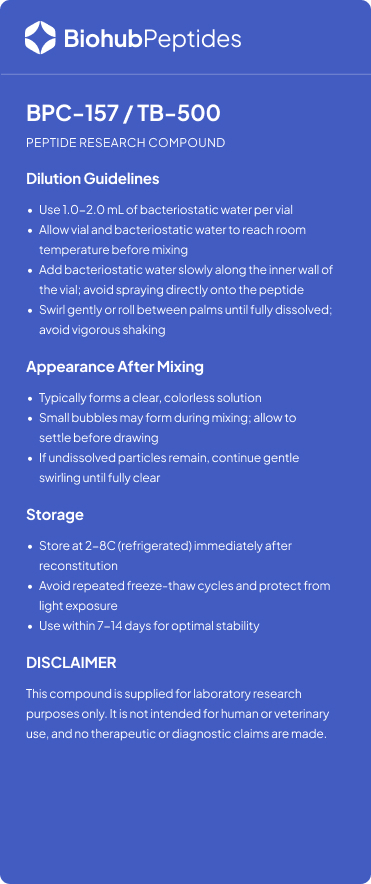
Store lyophilized blend at -20C for long-term stability, or at 2-8C for short-term use. Protect from heat, moisture, and direct light. Store reconstituted solutions at 2-8C and use promptly. Avoid repeated freeze-thaw cycles.
Compliance Notice
BPC-157/TB-500 Blend is for laboratory research use only. It is not for human or veterinary use and carries no therapeutic, diagnostic, or clinical indication. This product has not been evaluated by the FDA. By purchasing this product, the buyer confirms it will use it exclusively for controlled research following appropriate institutional safety procedures.