Description
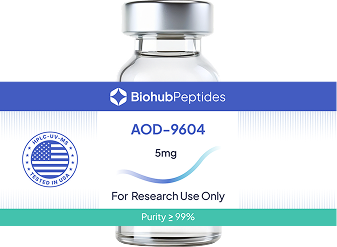
AOD-9604 is a synthetic fragment of the human growth hormone sequence studied in controlled laboratory environments for its interaction with beta-3 adrenergic receptors and lipid metabolism signaling pathways, independent of the broader growth-promoting effects associated with full-length GH.
Chemical Information
- Chemical Name: AOD-9604 (Anti-Obesity Drug 9604; Tyr-hGH Fragment 177-191)
- Also Known As: HGH Fragment 177-191; Tyr-hGH 176-191; Lipotropin
- Compound Class: Synthetic GH C-terminal fragment analog (Tyr-substituted); beta-3 adrenergic receptor pathway modulator; non-GH receptor-binding lipolytic fragment
- Sequence: Tyr-Leu-Arg-Ile-Val-Gln-Cys-Arg-Ser-Val-Glu-Gly-Ser-Cys-Gly-Phe
- Molecular Formula: C78H123N23O23S2
- Molecular Weight: 1,815.12 g/mol
- CAS Number: 221231-10-3
- Disulfide Bridge: Cys7-Cys14 (intramolecular; present in native sequence and preserved in AOD-9604)
- N-terminal modification: Tyr substitution (versus native Phe in H-Fragment 176-191) — introduced specifically to enable radioiodination (125I labeling) for receptor binding assays and pharmacokinetic tracing
- Key mechanistic distinction: Does not bind GH receptor; does not stimulate IGF-1 production; operates exclusively through beta-3 adrenergic receptor pathway in adipose tissue
- Clinical history: Completed six human clinical trials (Phase I through IIb) involving over 900 participants during development by Metabolic Pharmaceuticals Ltd. in Australia during the 1990s-2000s; no approved indication resulted
Applications
- Beta-3 adrenergic receptor (ADRB3) pathway research in adipose tissue models. The Heffernan et al. 2001 (Endocrinology) study established the mechanistic basis. Effects of both AOD-9604 and H-Fragment 176-191 were completely abolished in beta-3-AR knockout mice while remaining intact in wild-type controls, confirming ADRB3 as the obligate receptor. The downstream cascade is Gs-coupled cAMP elevation, PKA activation, and initiation of lipolytic signaling in white and brown adipose tissue cell models
- GH receptor-independent lipid metabolism pathway research. AOD-9604 does not bind the GH receptor and produces no IGF-1 elevation or glucose metabolism changes; it is specifically studied for adipose tissue lipid metabolism biology that is mechanistically downstream of ADRB3 activation rather than GH receptor engagement; this makes it appropriate for experiments studying lipolysis independently of the GH-IGF-1 axis
- Comparative research with H-Fragment 176-191 on N-terminal substitution effects. AOD-9604 (Tyr N-terminus) and H-Fragment 176-191 (native Phe N-terminus) share the same core sequence and ADRB3-dependent mechanism; the single N-terminal amino acid change was introduced for radioiodination capability; comparative binding assays using the two compounds examine whether the Tyr-versus-Phe difference affects ADRB3 binding affinity, enzymatic stability, or downstream cAMP response
- Radioiodination and pharmacokinetic research. The Tyr N-terminus of AOD-9604 enables 125I radiolabeling, making it the appropriate form for receptor binding assays requiring a radioactively labeled tracer and for pharmacokinetic distribution studies examining adipose tissue localization in animal models
- Antilipogenic versus lipolytic mechanism dissection. Published research documents both lipolysis stimulation and lipogenesis inhibition as effects of the GH C-terminal fragment via ADRB3. AOD-9604 is used in models examining which of these adipose tissue effects predominates under different experimental conditions (acute versus chronic exposure; white versus brown adipose tissue cell types; different ADRB3 expression levels)
Storage and Handling
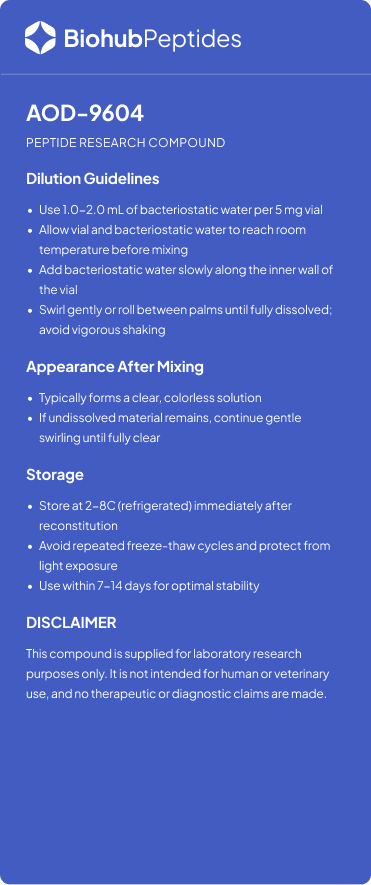
Store lyophilized powder at -20C for long-term stability, or at 2-8C for short-term use. Protect from heat, moisture, and direct light. Avoid reducing agents in reconstitution buffers. AOD-9604 contains a Cys7-Cys14 disulfide bridge that is disrupted by DTT, beta-mercaptoethanol, and other reducing conditions. Therefore, store reconstituted solutions at 2-8C and use promptly. Avoid repeated freeze-thaw cycles.
Compliance Notice
AOD-9604 is for laboratory research use only. It is not for human or veterinary use and carries no therapeutic, diagnostic, or clinical indication. This product has not been evaluated by the FDA. By purchasing this product, the buyer confirms it will use it exclusively for controlled research following appropriate institutional safety procedures.