Description
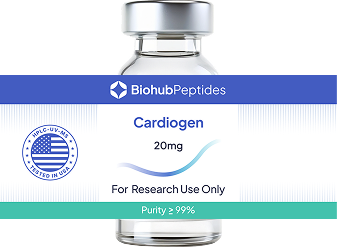
Cardiogen is a synthetic tetrapeptide bioregulator. It was developed by Professor Vladimir Khavinson at the St. Petersburg Institute of Bioregulation and Gerontology as part of a systematic program identifying tissue-specific short peptide regulators. Unlike receptor-binding peptides that initiate signaling at the cell surface, Cardiogen has the capacity to enter cardiomyocyte nuclei directly and interact with specific DNA promoter regions and histone complexes. This intranuclear mode of action distinguishes it from specialty research peptides that operate through GPCRs or receptor tyrosine kinases.
Chemical Information
- Chemical Name: Cardiogen (Ala-Glu-Asp-Arg; AEDR tetrapeptide)
- Also Known As: AEDR; cardiac tissue bioregulator tetrapeptide
- Compound Class: Khavinson series synthetic tetrapeptide bioregulator; cytogen (defined sequence, fully characterizable by analytical methods)
- Sequence: Ala-Glu-Asp-Arg
- Molecular Weight: approximately 502.5 g/mol
- Tissue Origin: Derived from cardiac tissue extract analysis via Khavinson methodology at the St. Petersburg Institute of Bioregulation and Gerontology
- Mechanism Class: Intranuclear peptide-DNA interaction; sequence-specific gene promoter binding in cardiac cell populations
- KED-family position: AEDR shares the acidic Glu-Asp core dipeptide with several Khavinson bioregulators but differs in N-terminal (Ala versus Lys) and C-terminal (Arg versus Pro/Trp/Gly/Ala) residues
Applications
- Cardiac tissue gene regulation research through intranuclear DNA-binding. The intranuclear mechanism documented for Khavinson class cytogen compounds involves sequence-specific binding to DNA promoter regions that regulate tissue-specific gene expression programs. In cardiomyocyte and cardiac fibroblast models, researchers examine how AEDR sequence interacts with cardiac gene promoters and which downstream gene expression changes it produces
- Comparative cardiac versus other tissue bioregulator research. Systematic comparison of Cardiogen (AEDR; cardiac) against Pancragen (KEDW; pancreas), Vesugen (KED; vascular endothelium), Prostamax (KEDP; prostate), and Livagen (KEDA; liver/lymphocyte) in the same cardiomyocyte versus non-cardiac cell model examines whether the tissue specificity of each bioregulator is intrinsic to the compound’s DNA-binding selectivity or depends on cell-specific transcription factor context
- Khavinson cytogen versus cytomax research. As a cytogen, Cardiogen can be completely characterized by HPLC, LC-MS/MS, and amino acid sequencing. This is something cytomax compounds (polypeptide extracts like Thymalin) can not be.
- Cardiomyocyte gene expression studies under oxidative or hypoxic stress. Cardiogen, as the defined cardiac-targeted compound, enables studies examining whether intranuclear DNA-binding peptides can modulate stress-response gene expression in cardiac cell populations
- AEDR sequence structure-activity research. The Ala N-terminus and Arg C-terminus of Cardiogen create a distinct charge and hydrophobicity profile from the KED-family tetrapeptides. Molecular docking studies using Cardiogen versus KED-family compounds against cardiac gene promoter sequences can characterize how the different flanking residues affect DNA-binding affinity and specificity
Storage and Handling
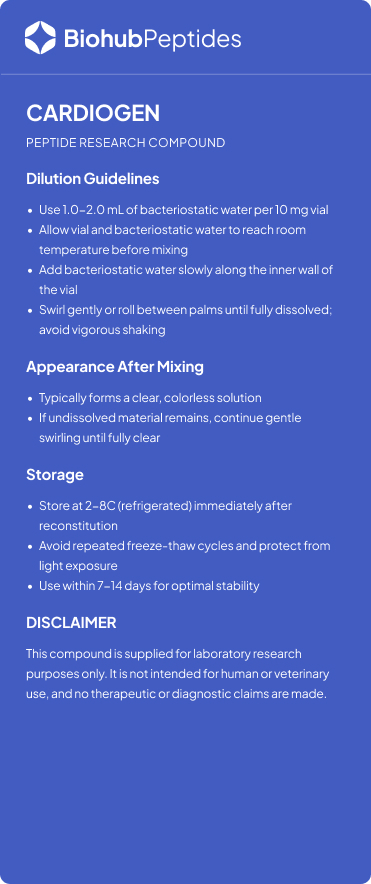
Store lyophilized powder at -20C for long-term stability, or at 2-8C for short-term use. Protect from heat, moisture, and direct light. As a tetrapeptide, Cardiogen is susceptible to proteolytic degradation under suboptimal storage conditions. Store reconstituted solutions at 2-8C and use promptly. Avoid repeated freeze-thaw cycles.
Compliance Notice
Cardiogen is for laboratory research use only. It is not for human or veterinary use and carries no therapeutic, diagnostic, or clinical indication. This product has not been evaluated by the FDA. By purchasing this product, the buyer confirms that it will use it exclusively for controlled research following appropriate institutional safety procedures.