Description
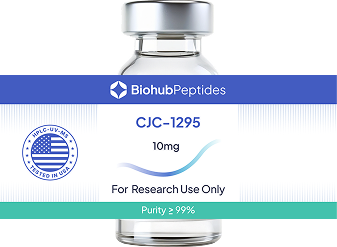
CJC-1295 no DAC is a modified 29-amino-acid synthetic analog of growth hormone-releasing hormone (GHRH). Four amino acid substitutions in the native GHRH(1-29) sequence increase enzymatic resistance and improve receptor binding relative to unmodified GHRH — but without the albumin-binding Drug Affinity Complex that defines the DAC variant. The result is a compound with a half-life of approximately 30 minutes that activates the GHRH receptor (GHRHR) on pituitary somatotrophs, producing a defined, short-duration cAMP-mediated signaling window. Researchers use it specifically when pulsatile GHRH signaling, rather than sustained axis stimulation, is the experimental condition being studied.
Chemical Information
- Chemical Name: CJC-1295 No DAC (Modified GRF 1-29; tetrasubstituted GHRH 1-29 analog)
- Also Known As: Modified GRF(1-29); Mod GRF 1-29; tetrasubstituted GRF(1-29)
- Compound Class: Synthetic 29-amino acid GHRH analog; GHRHR full agonist; DPP-4 resistant; pulsatile GH release profile
- Sequence: Tyr-D-Ala-Asp-Ala-Ile-Phe-Thr-Gln-Ser-Tyr-Arg-Lys-Val-Leu-Ala-Gln-Leu-Ser-Ala-Arg-Lys-Leu-Leu-Gln-Asp-Ile-Leu-Ser-Arg-NH2
- Molecular Formula: C152H252N44O42
- Molecular Weight: approximately 3,368 Da
- CAS Number: 446036-97-1
- Four substitutions vs Sermorelin: D-Ala at position 2 (blocks DPP-4 cleavage at Tyr-D-Ala N-terminus); Gln at position 8 (prevents asparagine deamidation and hydrolysis); Ala at position 15 (additional protease resistance); Leu at position 27 (metabolic stability)
- Half-life: approximately 30 minutes (versus 11-12 minutes for Sermorelin; 2 minutes for native GHRH)
Applications
- DPP-4 N-terminal resistance research. The D-Ala2 substitution is the single most mechanistically important modification distinguishing CJC-1295 No DAC from Sermorelin. Comparative DPP-4 degradation assays using Sermorelin (DPP-4 susceptible at Tyr-Ala) and CJC-1295 No DAC (DPP-4 resistant at Tyr-D-Ala) directly quantify the half-life contribution of this single N-terminal stereochemical change
- Asparagine deamidation stability research. The Gln8 substitution addresses a chemical (non-enzymatic) degradation pathway distinct from DPP-4 cleavage. Experiments comparing intact versus deamidated GHRH analogs in GHRHR binding assays characterize how asparagine deamidation at position 8 affects receptor engagement independent of enzymatic degradation
- Pulsatile GHRHR activation studies requiring improved stability over Sermorelin. CJC-1295 No DAC’s 30-minute window provides a cleaner, more reproducible receptor engagement interval than Sermorelin’s 11-12 minutes while preserving the pulsatile GH release profile that CJC-1295 DAC eliminates. Appropriate when Sermorelin’s rapid clearance creates variability in cell-based assay readouts
- GHRH analog half-life spectrum studies. systematic comparison across the series: native GHRH (~2 min), Sermorelin (~11-12 min), CJC-1295 No DAC (~30 min), Tesamorelin (~30-38 min), CJC-1295 DAC (~6-8 days) in the same somatotroph model characterizes how increasing plasma half-life affects GH pulse amplitude, shape, and downstream IGF-1 responses independently of receptor selectivity differences
- Dual-pathway GHRHR/GHSR-1a combination research. CJC-1295 No DAC is the standard GHRHR component in combination blend research with GHSR-1a agonists (Ipamorelin, GHRP-2, GHRP-6). Its pulsatile profile is appropriate for combination studies where physiological GH pulse dynamics need to be preserved alongside ghrelin receptor pathway activation
Storage and Handling
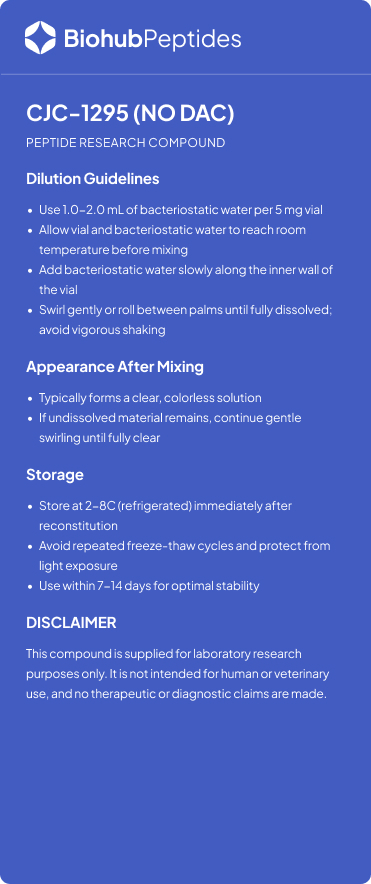
Store lyophilized powder at -20C for long-term stability, or at 2-8C for short-term use. Protect from heat, moisture, and direct light. Reconstituted solutions should be stored at 2-8C and used promptly. Avoid repeated freeze-thaw cycles.
Compliance Notice
CJC-1295 (No DAC) is for laboratory research use only. It is not for human or veterinary use and carries no therapeutic, diagnostic, or clinical indication. This product has not been evaluated by the FDA. By purchasing this product, the buyer confirms that they will follow appropriate institutional safety procedures and use it exclusively for controlled research.