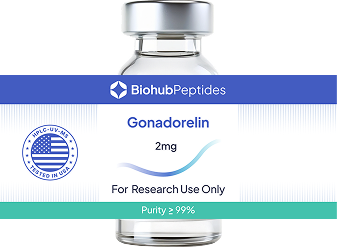
Description
Gonadorelin is a synthetic decapeptide structurally identical to endogenous gonadotropin-releasing hormone (GnRH), the hypothalamic neuropeptide that drives the hypothalamic-pituitary-gonadal (HPG) axis. Its plasma half-life of approximately 2–8 minutes makes it a precise tool for studying pulsatile HPG axis signaling. This is the same reproductive axis regulation that Kisspeptin probes from the upstream hypothalamic level.
Chemical Information
- Chemical Name: Gonadorelin (pGlu-His-Trp-Ser-Tyr-Gly-Leu-Arg-Pro-Gly-NH2)
- Also Known As: GnRH; LHRH (luteinizing hormone-releasing hormone); Gonadoliberin
- Compound Class: Synthetic decapeptide; hypothalamic releasing hormone (identical sequence to native GnRH)
- Sequence: pGlu-His-Trp-Ser-Tyr-Gly-Leu-Arg-Pro-Gly-NH2
- Molecular Formula: C55H75N17O13
- Molecular Weight: 1182.3 g/mol
- CAS Number: 33515-09-2
Applications
- HPG-axis and pulsatile GnRH signaling research. Gonadorelin binds the GnRH receptor on pituitary gonadotrope cells. Pulsatile receptor activation drives LH and FSH synthesis and release, making it the reference tool for studying pulsatile GnRH receptor activation, given that its sequence matches endogenous GnRH exactly, unlike synthetic long-acting analogs
- GnRH agonist and antagonist comparator research. Sustained, non-pulsatile GnRH receptor exposure downregulates the receptor and paradoxically suppresses gonadotropin release. Thus, Gonadorelin is used as the short-acting, pulsatile-release comparator against long-acting GnRH agonists (which exploit this downregulation for gonadal suppression) and GnRH antagonists (which block the receptor directly)
- Gonadotrope cell and pituitary function research. In vitro and in vivo research characterize gonadotrope responsiveness, receptor density changes, and feedback regulation by gonadal steroids within the HPG axis
- Diagnostic-model research (GnRH stimulation test). The GnRH stimulation test paradigm, measuring LH/FSH response to a Gonadorelin challenge, is used in research models studying pituitary reserve and differentiating hypothalamic from pituitary origins of gonadotropin dysregulation
Storage and Handling
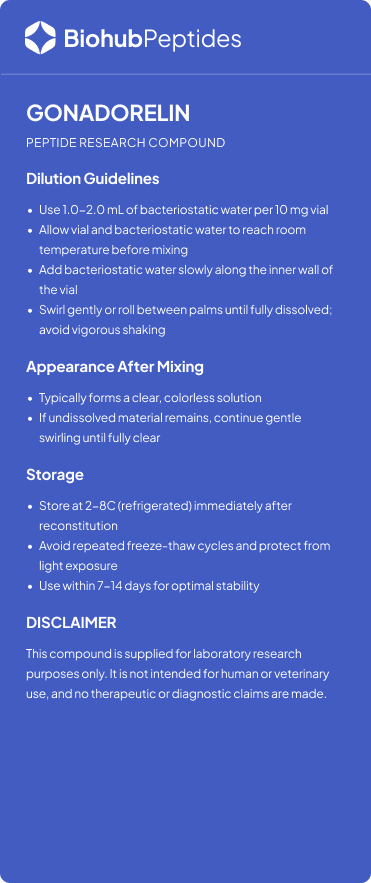
Store lyophilized powder at -20C for long-term stability, or at 2-8C for short-term use. Protect from heat, moisture, and direct light. Gonadorelin is a hydrophilic peptide that reconstitutes readily in aqueous buffer; store reconstituted solution at 2-8C and use promptly, avoiding repeated freeze-thaw cycles.
Compliance Notice
Gonadorelin is for laboratory research use only. It is not for human or veterinary use and carries no therapeutic, diagnostic, or clinical indication. This product has not been evaluated by the FDA. By purchasing this product, the buyer confirms that they will follow appropriate institutional safety procedures and use it exclusively for controlled research.