Description
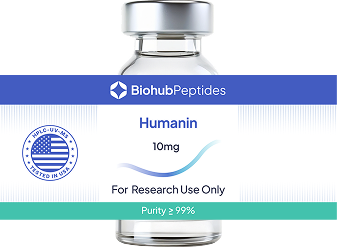
Humanin is a 21-amino-acid mitochondrial-derived peptide (MDP) encoded within the 16S rRNA region of the mitochondrial genome, the first of its kind ever identified. Its discovery fundamentally expanded the understood role of mitochondria from purely metabolic organelles to active sources of signaling peptides that influence cell survival under stress conditions. Humanin is studied for its cytoprotective and anti-apoptotic properties across multiple cell types. It acts both intracellularly through JAK/STAT signaling and BCL-2 family protein interactions, and extracellularly through the FPR2 membrane receptor in autocrine, paracrine, and endocrine signaling contexts.
Chemical Information
- Chemical Name: Humanin (MAPRGFSCLLLLTSEIDLPVKRRA)
- Also Known As: HN; mitochondrial-derived peptide (MDP)
- Compound Class: Mitochondrial-derived peptide (MDP); cytoprotective signaling peptide encoded within the mitochondrial 16S rRNA gene
- Sequence: Met-Ala-Pro-Arg-Gly-Phe-Ser-Cys-Leu-Leu-Leu-Leu-Thr-Ser-Glu-Ile-Asp-Leu-Pro-Val-Lys-Arg-Arg-Ala
- Molecular Formula: C122H197N33O34S
- Molecular Weight: 2687.2 g/mol
- CAS Number: 328099-24-1
Applications
- Mitochondrial-derived peptide (MDP) signaling research. Humanin is encoded by a short open reading frame within the mitochondrial 16S ribosomal RNA gene rather than nuclear DNA. Once released extracellularly, it signals through a receptor complex involving formyl-peptide receptor-like 1 (FPRL1) and a co-receptor complex including WSX-1/CNTFR, activating STAT3 and other prosurvival cascades. It is a key reference compound for the emerging class of peptides encoded within mitochondrial DNA, studied alongside MOTS-c to characterize the broader signaling roles of mitochondrially encoded peptides
- Cytoprotection and apoptosis-suppression research. Published work has examined Humanin’s anti-apoptotic activity through interactions with Bax and IGFBP-3. It noted that it is a tool for studying mitochondrial-linked cell survival pathways in neuronal and other cell models under stress conditions
- Comparative mitochondrial peptide mechanism research. Humanin (FPRL1/STAT3-linked cytoprotection) and MOTS-c (AMPK-linked metabolic signaling) represent two mechanistically distinct arms of mitochondrial-derived peptide biology. As such, researchers use them together to map the functional diversity of this peptide class
- Cellular stress-response and aging-biology research. Humanin levels have been studied as a marker of mitochondrial function across aging models, supporting its use as a research tool in cellular senescence and stress-resilience study designs
Storage and Handling
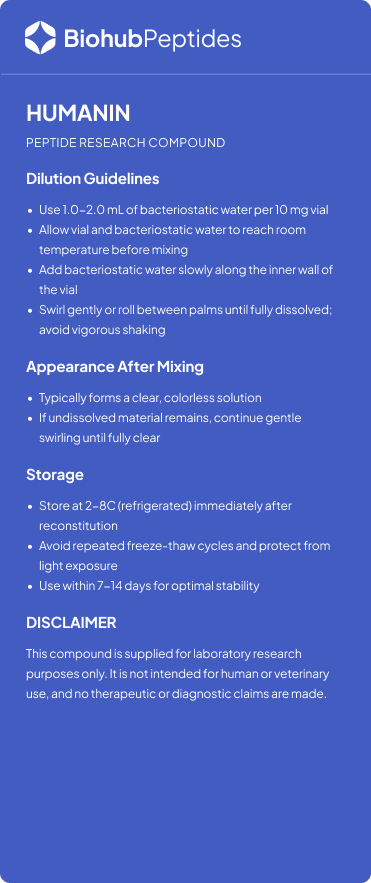
Store lyophilized powder at -20C for long-term stability, or at 2-8C for short-term use. Protect from heat, moisture, and direct light. Reconstitute with sterile water or an appropriate aqueous buffer immediately before use. Store reconstituted solution at 2-8C and avoid repeated freeze-thaw cycles.
Compliance Notice
Humanin is for laboratory research use only. It is not for human or veterinary use and carries no therapeutic, diagnostic, or clinical indication. This product has not been evaluated by the FDA. By purchasing this product, the buyer confirms that they will follow appropriate institutional safety procedures and use it exclusively for controlled research.