Description
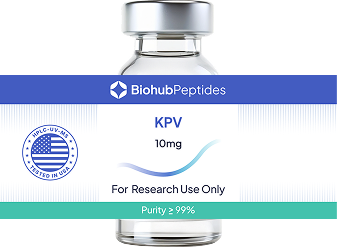
KPV is a naturally occurring tripeptide corresponding to positions 11–13 of alpha-melanocyte-stimulating hormone (alpha-MSH) — the C-terminal sequence Lys-Pro-Val. Structure-activity relationship studies systematically identified this fragment as the region of alpha-MSH that carries anti-inflammatory signaling capacity through a receptor-independent mechanism, distinct from the central core sequence (residues 6–9) responsible for melanocortin receptor binding and pigmentation effects. KPV enters cells via PepT1 di/tripeptide transporter-mediated uptake, undergoes nuclear import, and suppresses NF-κB activation by stabilizing IκBα and blocking p65 subunit nuclear translocation — a mechanism that makes it a useful research tool for studying specialty research peptide inflammatory signaling independently of receptor-mediated melanocortin pathway activity.
Chemical Information
- Chemical Name: KPV (Lys-Pro-Val)
- Also Known As: alpha-MSH(11-13); C-terminal tripeptide fragment of alpha-melanocyte-stimulating hormone
- Compound Class: Synthetic tripeptide; anti-inflammatory fragment of alpha-MSH
- Sequence: Lys-Pro-Val
- Molecular Formula: C16H30N4O4
- Molecular Weight: 342.4 g/mol
- CAS Number: 12629-01-5
Applications
- Anti-inflammatory and NF-kB pathway research. KPV corresponds to the smallest active C-terminal fragment of alpha-MSH and retains anti-inflammatory activity independent of alpha-MSH’s melanocortin-receptor-mediated pigmentation effects; published work indicates it modulates NF-kB signaling and suppresses cytokine production (TNF-alpha, IL-1beta) in immune and epithelial cell models, without significant engagement of classical melanocortin receptors (MC1R-MC5R)
- Gut epithelial and inflammatory bowel research models. Published work has examined KPV’s effects on intestinal epithelial cell inflammatory signaling, supporting its use in research models of gut barrier function and mucosal inflammation
- Alpha-MSH structure-activity and receptor-independence research. Because KPV reproduces alpha-MSH’s anti-inflammatory activity without significant melanocortin receptor binding, it is used in comparative study designs alongside full-length alpha-MSH and Melanotan II to dissect which alpha-MSH effects require receptor engagement and which occur through receptor-independent mechanisms
- Skin and wound-healing inflammatory signaling research. KPV’s anti-inflammatory profile has also been studied in dermal and wound-healing cell models, alongside other regenerative research peptides such as GHK-Cu and BPC-157, for comparative research on inflammatory versus reparative signaling arms
Storage and Handling
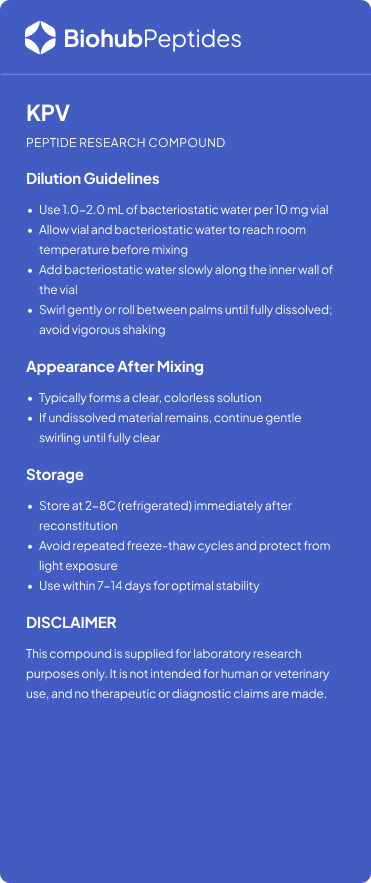
Store lyophilized powder at -20C for long-term stability, or at 2-8C for short-term use. Protect from heat, moisture, and direct light. KPV dissolves readily in aqueous buffer; store reconstituted solution at 2-8C and use promptly, avoiding repeated freeze-thaw cycles.
Compliance Notice
KPV is for laboratory research use only. It is not for human or veterinary use and carries no therapeutic, diagnostic, or clinical indication. This product has not been evaluated by the FDA. By purchasing this product, the buyer confirms that they will follow appropriate institutional safety procedures and use it exclusively for controlled research.