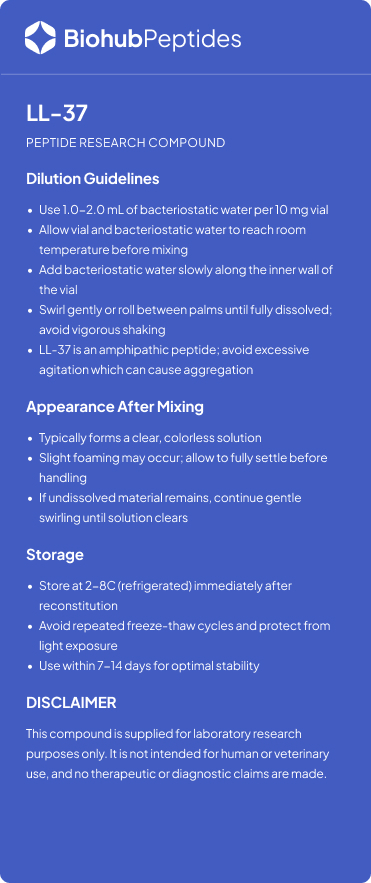
Description
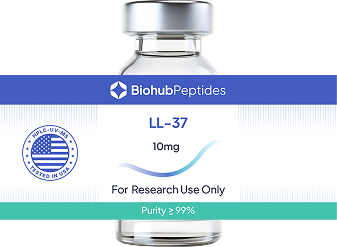
LL-37 is the only human cathelicidin, a 37-amino acid amphipathic alpha-helical peptide cleaved from its 18-kDa precursor protein hCAP18 by proteinase 3. Its name reflects both its length and the two leucine residues at its N-terminus. Produced by neutrophils, macrophages, mast cells, and epithelial cells as part of the first-line innate immune response, LL-37 operates through direct membrane disruption of microbial lipid bilayers via electrostatic interaction with negatively charged phospholipid head groups. Beyond direct antimicrobial activity, it modulates innate immune signaling through LPS endotoxin neutralization, immune cell chemotaxis, and biofilm disruption. This multi-functional profile makes it a central research tool in specialty research peptide innate immunity models.
Chemical Information
- Chemical Name: LL-37 (LLGDFFRKSKEKIGKEFKRIVQRIKDFLRNLVPRTES)
- Also Known As: CAP-18 (37-residue active fragment); cathelicidin antimicrobial peptide
- Compound Class: Human host-defense peptide; cathelicidin family antimicrobial and immunomodulatory peptide
- Sequence: Leu-Leu-Gly-Asp-Phe-Phe-Arg-Lys-Ser-Lys-Glu-Lys-Ile-Gly-Lys-Glu-Phe-Lys-Arg-Ile-Val-Gln-Arg-Ile-Lys-Asp-Phe-Leu-Arg-Asn-Leu-Val-Pro-Arg-Thr-Glu-Ser
- Molecular Formula: C205H340N60O59
- Molecular Weight: 4493.3 g/mol
- CAS Number: 197961-49-4
Applications
- Antimicrobial mechanism and membrane-disruption research. LL-37 is the only cathelicidin-family antimicrobial peptide expressed in humans, proteolytically cleaved from the precursor protein hCAP-18. Its amphipathic alpha-helical structure disrupts negatively charged bacterial membranes, making it a reference compound for studying cationic host-defense peptide activity against Gram-positive and Gram-negative bacteria
- Innate immune signaling and chemotaxis research. Beyond direct membrane disruption, LL-37 engages host cell receptors including formyl peptide receptor 2 (FPR2) and P2X7, driving immune cell chemotaxis and cytokine release modulation, supporting its use in innate immunity and inflammatory signaling research
- Wound healing and angiogenesis research. LL-37 has documented pro-angiogenic and keratinocyte-migration-promoting effects, making it a tool for studying peptide-mediated wound repair alongside other regenerative research peptides such as GHK-Cu and BPC-157
- Antimicrobial resistance and peptide antibiotic research. As a naturally occurring antimicrobial peptide with a membrane-targeting mechanism, LL-37 is used in comparative research on peptide-based antimicrobial strategies as an alternative to conventional small-molecule antibiotics, particularly in resistance-related study designs
Storage and Handling
Store lyophilized powder at -20C for long-term stability, or at 2-8C for short-term use. Protect from heat, moisture, and direct light. Reconstitute with sterile water or an appropriate aqueous buffer immediately before use; store reconstituted solution at 2-8C and avoid repeated freeze-thaw cycles.
Compliance Notice
LL-37 is for laboratory research use only. It is not for human or veterinary use and carries no therapeutic, diagnostic, or clinical indication. This product has not been evaluated by the FDA. By purchasing this product, the buyer confirms that they will follow appropriate institutional safety procedures and use it exclusively for controlled research.