Description
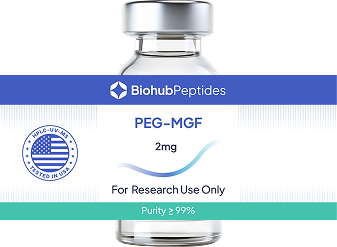
PEG-MGF is the pegylated form of the MGF E-domain peptide. That is the same 24-amino acid IGF-1Ec splice variant sequence as MGF, modified by the attachment of polyethylene glycol (PEG) chains to extend its biological half-life from minutes to approximately 24 hours. The PEGylation does not alter the receptor interaction or the satellite cell activation biology of the E-domain peptide. Instead, it changes only the pharmacokinetic profile, making sustained-exposure research protocols practical. Researchers studying satellite cell biology and recovery peptide mechanosensory signaling select between MGF and PEG-MGF based on whether the experimental protocol requires a short acute signal or a prolonged exposure window — the biological question is the same, the observation duration is not.
Chemical Information
- Chemical Name: PEG-MGF (pegylated Mechano Growth Factor)
- Also Known As: Pegylated IGF-1Ec C-terminal peptide
- Compound Class: PEGylated synthetic peptide fragment; extended-half-life derivative of MGF (the IGF-1Ec splice variant peptide)
- Sequence: Not established as a single standardized commercial sequence; preparations correspond to a polyethylene glycol-conjugated form of the MGF C-terminal E-domain region and should be confirmed against the certificate of analysis
- Molecular Formula: Not established in public literature for the pegylated conjugate
- Molecular Weight: Not established in public literature for the pegylated conjugate (varies by PEG chain length used in a given preparation)
- CAS Number: Not established in public literature
Applications
- Extended systemic exposure research alongside native MGF. Native MGF has a very short circulating half-life. PEGylation is a standard modification used to extend a peptide’s systemic residence time by increasing hydrodynamic size and reducing renal clearance and proteolytic degradation, and PEG-MGF is used specifically to study prolonged systemic exposure effects in contrast to the transient, locally-acting signaling of native MGF
- Satellite cell activation and muscle regeneration research. PEG-MGF retains the core MGF sequence responsible for satellite cell activation in muscle repair models. Therefore, it is studied for its ability to sustain this signaling over a longer window than native MGF permits
- Comparative pharmacokinetics research. PEG-MGF and native MGF are used together in research designs comparing short-lived local signaling versus prolonged systemic peptide exposure, a common comparison in growth factor pharmacology
Storage and Handling
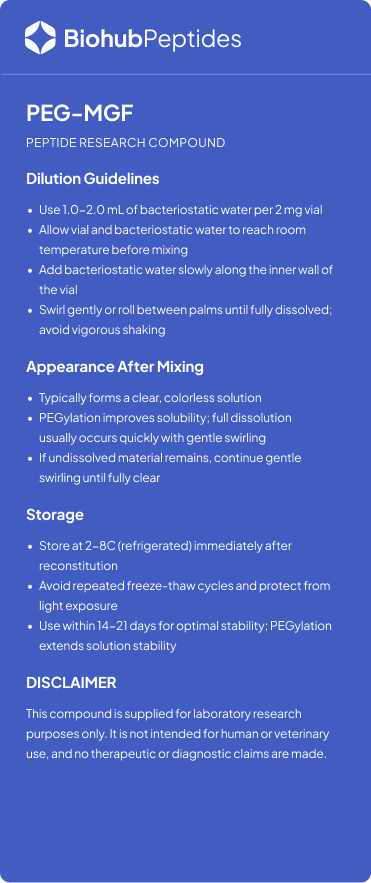
Store lyophilized powder at -20C for long-term stability, or at 2-8C for short-term use. Protect from heat, moisture, and direct light. Reconstitute immediately before use, store reconstituted solution at 2-8C, use promptly, and avoid repeated freeze-thaw cycles.
Compliance Notice
PEG-MGF is for laboratory research use only. It is not for human or veterinary use and carries no therapeutic, diagnostic, or clinical indication. FDA has not evaluated this product. By purchasing this product, the buyer confirms that they will follow appropriate institutional safety procedures and use it exclusively for controlled research.