
Description
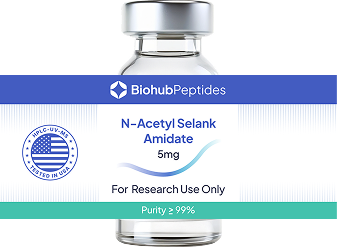
N-Acetyl Selank Amidate is a terminally modified analog of Selank — the tuftsin-derived heptapeptide studied for GABAergic signaling and neuroimmune interaction in nootropic peptide CNS research. N-terminal acetylation and C-terminal amidation are added to the core Thr-Lys-Pro-Arg-Pro-Gly-Pro sequence, protecting both termini from aminopeptidase and carboxypeptidase-mediated degradation. The tuftsin-analog sequence and the GABAergic inhibitory and neuroimmune signaling research context it carries are unchanged — the modification addresses the pharmacokinetic limitation of rapid proteolytic clearance that constrains unmodified Selank in longer-duration experimental protocols.
Chemical Information
- Chemical Name: N-Acetyl Selank Amidate (N-acetylated, C-terminally amidated analog of Selank)
- Also Known As: Ac-Selank-NH2; acetylated Selank amide
- Compound Class: Modified synthetic heptapeptide analog; stability-enhanced derivative of Selank, an anxiolytic-profile analog of the immunomodulatory tetrapeptide tuftsin
- Sequence: N-acetyl-Thr-Lys-Pro-Arg-Pro-Gly-Pro-amide (N-terminal acetylation and C-terminal amidation of the parent Selank sequence)
- Molecular Formula: Not established in public literature for the modified analog (parent Selank: C33H57N11O9)
- Molecular Weight: Not established in public literature for the modified analog (parent Selank: 751.87 g/mol)
- CAS Number: Not established in public literature for the modified analog (parent Selank: 129954-34-3)
Applications
- Peptide stability and pharmacokinetic modification research. N-terminal acetylation and C-terminal amidation are standard modifications that reduce degradation by aminopeptidases and carboxypeptidases. Therefore, researchers use this analog alongside unmodified Selank to study how these terminal modifications affect proteolytic resistance and duration of activity in cell-based and animal assays
- Anxiolytic and stress-response signaling research. Because the modified analog retains Selank’s core heptapeptide sequence, it is studied within the same research framework as the parent compound, which has been examined for effects on GABAergic signaling, BDNF expression, and stress-related behavior in animal models
- Comparative structure-activity research alongside unmodified Selank. Researchers use N-Acetyl Selank Amidate and unmodified Selank side by side to assess whether terminal modification changes receptor engagement, degradation kinetics, or downstream signaling outcomes
Storage and Handling
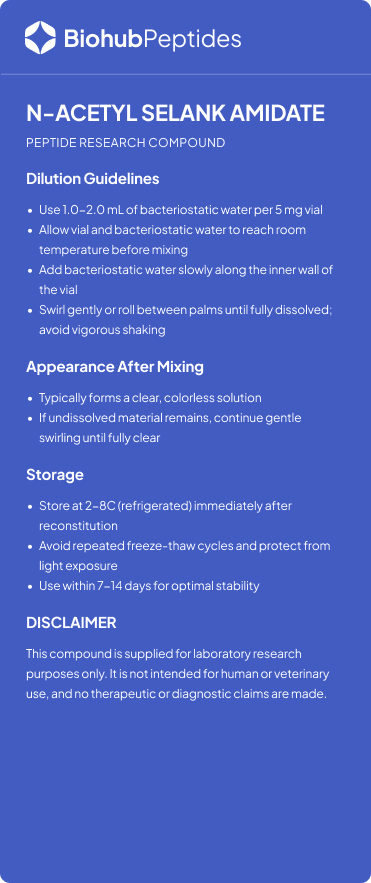
Store lyophilized powder at -20C for long-term stability, or at 2-8C for short-term use. Protect from heat, moisture, and direct light. Reconstitute with an appropriate aqueous buffer immediately before use; store reconstituted solution at 2-8C and avoid repeated freeze-thaw cycles.
Compliance Notice
N-Acetyl Selank Amidate is for laboratory research use only. It is not for human or veterinary use and carries no therapeutic, diagnostic, or clinical indication. FDA has not evaluated this product. By purchasing this product, the buyer confirms that they will follow appropriate institutional safety procedures and use it exclusively for controlled research.



