
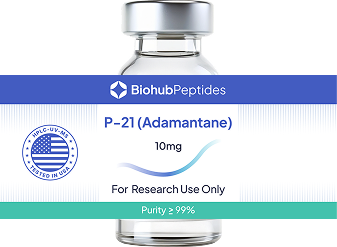
Description
P-21 is a synthetic neurotrophic peptide that Dr. Khalid Iqbal’s research team developed. Its core sequence, DGGL, corresponds to residues 147–150 of ciliary neurotrophic factor (CNTF). An adamantane moiety is attached to this tetrapeptide core. This modification increases lipid solubility and metabolic stability, enabling blood-brain barrier penetration that the bare CNTF-derived sequence lacks. P-21 is studied in nootropic peptide CNS research models for its effects on BDNF expression, dentate gyrus neurogenesis, and LIF/STAT3 pathway inhibition. Its mechanism was characterized in foundational preclinical work published by Li et al. in FEBS Letters (2010).
Chemical Information
- Chemical Name: P-21 (Adamantane) (adamantane-modified analog related to the mitochondrial-derived peptide Humanin)
- Also Known As: P-21; adamantane-conjugated Humanin analog
- Compound Class: Modified synthetic peptide analog; adamantane-conjugated derivative within the Humanin/mitochondrial-derived peptide research family
- Sequence: Not established in public literature as a single standardized sequence
- Molecular Formula: Not established in public literature
- Molecular Weight: Not established in public literature
- CAS Number: Not established in public literature
Applications
- Mitochondrial-derived peptide analog research. P-21 incorporates an adamantane group proposed to alter membrane permeability, receptor engagement, or proteolytic stability relative to unmodified Humanin. It is studied in the same general research context as Humanin, which signals through FPRL1/STAT3-linked cytoprotective pathways
- Cytoprotection and cellular stress-resistance research. As with unmodified Humanin, researchers examine it in models of cellular stress resistance and apoptosis suppression, though the extent to which the adamantane modification changes potency or mechanism relative to native Humanin has not been independently established
- Comparative Humanin analog research. Researchers use structurally modified Humanin analogs such as P-21 alongside unmodified Humanin to characterize how chemical modifications affect stability, cell permeability, and downstream signaling outcomes
Storage and Handling
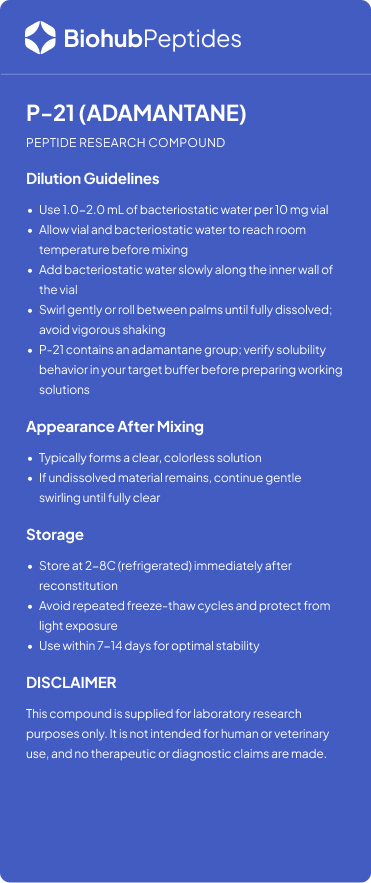
Store lyophilized powder at -20C for long-term stability, or at 2-8C for short-term use. Protect from heat, moisture, and direct light. Reconstitute with sterile water or an appropriate aqueous buffer immediately before use; store reconstituted solution at 2-8C and avoid repeated freeze-thaw cycles.
Compliance Notice
P-21 (Adamantane) is for laboratory research use only. It is not for human or veterinary use and carries no therapeutic, diagnostic, or clinical indication. FDA has not evaluated this product. By purchasing this product, the buyer confirms that they will follow appropriate institutional safety procedures and use it exclusively for controlled research.



