Description
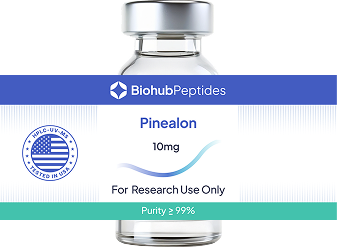
Pinealon is a synthetic tripeptide bioregulator with the sequence Glu-Asp-Arg (EDR), developed by Professor Vladimir Khavinson at the St. Petersburg Institute of Bioregulation and Gerontology. Despite its name suggesting pineal gland origin, Pinealon originates from brain cortex extract research. The same Cortexin-based work that produced Cortagen. The two compounds differ by a single amino acid at the C-terminus: Cortagen carries proline (AEDP), Pinealon carries arginine (EDR as a tripeptide). Pinealon enters neuronal cell nuclei and modulates gene expression through direct peptide-DNA interaction. Its documented specialty research targets include antioxidant enzyme expression, MAPK/ERK signaling timing, and cell cycle regulatory proteins in CNS cell models.
Chemical Information
- Chemical Name: Pinealon (Khavinson pineal gland/CNS-derived tripeptide bioregulator)
- Also Known As: Pinealon peptide complex
- Compound Class: Short-chain synthetic tripeptide; tissue-specific epigenetic bioregulator (Khavinson series)
- Sequence: Glu-Asp-Arg, though not confirmed
- Molecular Formula: Not established in public literature
- Molecular Weight: Not established in public literature (consistent with the broader Khavinson class of low molecular weight peptides, <10,000 Da)
- CAS Number: Not established in public literature
Applications
- CNS and pineal-adjacent tissue gene regulation research. Pinealon is modeled on pineal gland and central nervous system tissue and is proposed to act via direct peptide-DNA interaction within neuronal and glial cell nuclei. It shares this mechanism with as Cortagen (cerebral cortex) and Cardiogen (cardiomyocytes)
- Comparative neuroprotection and hypoxic stress research. Published work on structurally related cortex- and pineal-targeted Khavinson peptides has examined caspase-3 apoptotic pathway activity and cognitive performance in aged versus young animal models under hypoxic stress. Pinealon is studied within this comparative framework alongside Cortagen and Cortexin
- Cross-tissue bioregulator specificity research. Pinealon is proposed to share its intranuclear DNA-interaction mechanism with other short-chain Khavinson peptides. As a result, researchers use it alongside tissue-matched and mismatched bioregulators to test whether reported neuroprotective effects are tissue-restricted or tissue-general
Storage and Handling
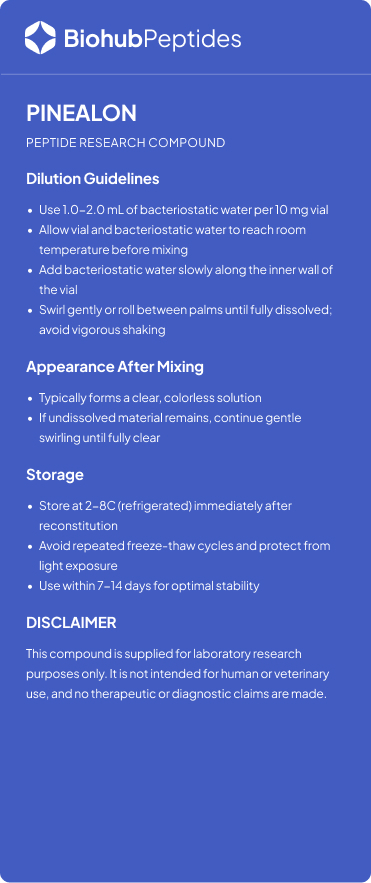
Store lyophilized powder under refrigeration (2-8C), protected from heat, light, and moisture. As a short-chain peptide, Pinealon is susceptible to proteolytic degradation once reconstituted. Reconstitute immediately before use, keep reconstituted solution refrigerated, and avoid repeated freeze-thaw cycles.
Compliance Notice
Pinealon is for laboratory research use only. It is not for human or veterinary use and carries no therapeutic, diagnostic, or clinical indication. FDA has not evaluated this product. By purchasing this product, the buyer confirms that they will follow appropriate institutional safety procedures and use it exclusively for controlled research.