Description
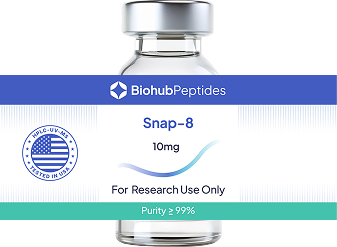
Snap-8 is a synthetic octapeptide developed by Lipotec SA as an extended analog of Argireline (acetyl hexapeptide-3). The two additional C-terminal residues, Ala-Asp, extend the sequence to eight amino acids. They also improve SNARE complex binding interaction relative to the six-residue parent. Snap-8 is a competitive inhibitor of SNARE complex assembly. It mimics the N-terminal SNAP-25 protein fragment and competes with endogenous SNAP-25 for syntaxin-1 binding sites — the initial contact step in SNARE complex formation. This competition reduces vesicle fusion efficiency at the neuromuscular junction and attenuates acetylcholine release per action potential. Researchers studying specialty research peptide neuromuscular signaling and SNARE-mediated exocytosis use Snap-8 as a tool for probing SNARE complex assembly without the irreversible cleavage associated with botulinum toxin approaches.
Chemical Information
- Chemical Name: SNAP-8 (Acetyl Octapeptide-3)
- Also Known As: Acetyl Octapeptide-3; SNAP-8
- Compound Class: Synthetic acetylated octapeptide; extended structural analog of the SNARE-fragment peptide Acetyl Hexapeptide-8 (Argireline)
- Sequence: N-acetyl-Glu-Glu-Met-Gln-Arg-Arg-Ala-Ser (extended by two residues relative to the hexapeptide Argireline sequence)
- Molecular Formula: Not established with a single confirmed public source
- Molecular Weight: Not established with a single confirmed public source
- CAS Number: Not established with a single confirmed public source
Applications
- SNARE complex and neurotransmitter release research. SNAP-8 is designed as a fragment-based mimetic of a region of SNAP-25, a component of the SNARE complex responsible for synaptic vesicle fusion and neurotransmitter release. It is studied for its proposed ability to interfere with SNARE complex assembly, in the same experimental category as botulinum toxin type A and the related peptide Argireline (Acetyl Hexapeptide-8)
- Comparative research alongside Argireline. As a two-residue-extended analog of Argireline, SNAP-8 is used in comparative cosmetic-science research examining whether the extended sequence changes potency, binding, or duration of SNARE-inhibitory effects relative to the shorter hexapeptide
- Topical muscle-relaxation signaling research. Published cosmetic-industry research has examined SNAP-8’s effects on facial muscle contraction signaling as a non-invasive research analog for botulinum toxin-like mechanisms, though independent, non-manufacturer-funded replication is limited
- Note on evidence base: Much of the published research on SNAP-8 originates from manufacturer-funded cosmetic-industry studies rather than independent academic sources. Researchers should weigh this when designing comparative studies
Storage and Handling
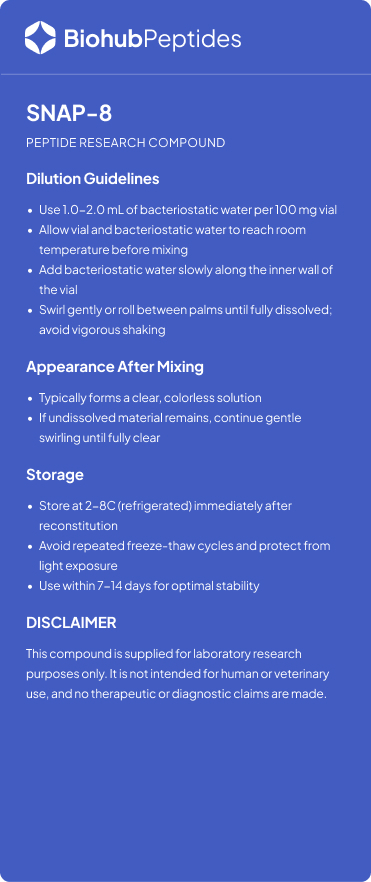
Store lyophilized powder at -20C for long-term stability, or at 2-8C for short-term use. Protect from heat, moisture, and direct light. Reconstitute with an appropriate aqueous buffer immediately before use; store reconstituted solution at 2-8C and avoid repeated freeze-thaw cycles.
Compliance Notice
SNAP-8 is for laboratory research use only. They are not for human or veterinary use and carry no therapeutic, diagnostic, or clinical indication. FDA has not evaluated this product. By purchasing this product, the buyer confirms that they will follow appropriate institutional safety procedures and use it exclusively for controlled research.